
 UAE
UAE
 United Kingdom
 Switzerland
 United States








 Italy
Italy France
 India
India UAE
UAE Germany
 Russia
 Malaysia
 Spain
Spain United States
 Malta
Malta
Global MBA vs Regular MBA
Global MBA vs Regular MBA
Choosing an MBA is a significant academic and professional move, but selecting between a Global MBA and a Traditional or Regular MBA can be perplexing at first. Both types of MBA fall under the same category as the Master of Business Administration — a post-graduate degree that aims to develop leadership, management, and analytical acumen in business professionals.
However, despite sharing the same roots, focus, exposure, and outcome, these two types of MBA are vastly different. Understanding these differences helps students synchronize their academic goals with their long-term professional goals, whether it is to work for global corporations or grow within the domestic industries.
Understanding a Global MBA
A Global MBA is designed for the interconnected world of business. The course is centered on global markets, cross-cultural management, and global business strategy, equipping students to work in a multinational setting.
The curriculum for Global MBA typically covers:
- Global markets and international finance
- Cross-cultural communication and leadership
- Strategic management in an international environment
- Global economics and trade dynamics
Some Global MBAs may also involve international case studies, multicultural teamwork, and global projects, which allow students to develop a worldwide perspective.
This type of MBA is most appropriate for:
- Professionals who want to have international careers
- Those who want to work in multinational companies
- Entrepreneurs interested in expanding their business globally
Because of its international orientation, a Global MBA tends to attract students from various countries and backgrounds, thus offering greater networking opportunities.
Understanding a Traditional MBA
Traditional MBA, also known as conventional or regular MBA degree, is focused on general management concepts that can be applied to any organizational environment, particularly in a domestic or national setting.
Some of the topics covered include:
- Finance
- Marketing
- Operations Management
- Strategy and Organizational Behavior
While a traditional MBA may cover some international topics, its primary objective is to prepare students with in-depth knowledge in business administration, which is essential for career mobility.
A traditional MBA program would be most suitable for:
- Students who are aiming for leadership roles in domestic companies
- Professionals seeking career advancement within their home country
- Individuals seeking flexible options for career change
Curriculum and Learning Approach
One of the most obvious differences is in academic design.
A Global MBA program comprises international viewpoints that are included throughout in the curriculum, and not only as elective modules. During the course, students study global supply chains, international law, and multinational strategies, often using case studies from around the world.
Contrastingly, a Traditional MBA concentrates on general management theories and practices, mainly for home markets. Case studies and examples are often drawn from the local environment.
Both are useful in their own way:
- Global MBA: Enhances strategic flexibility in global markets
- Traditional MBA: Improves operational decision-making capabilities
International Exposure and Cultural Intelligence
Global MBAs are basically created keeping in mind immersion and global teamwork. Students get to work with classmates from different countries, and they learn to deal with different cultures and communication styles. This, in turn, helps them build cultural intelligence, which is an important leadership quality if you are working in international environments.
The traditional MBA course, although sometimes incorporating global exchange programs or international electives, is normally focused on business practices in a particular country or region.
The Global MBA exposure may be a huge benefit to a student who intends to work globally or manage global teams.
Networking Opportunities
When it comes to networking, it is one of the greatest advantages of any MBA.
The Global MBA will offer a very diverse professional network, including peers, faculty, and external connections in a variety of countries. These connections may provide access to international business opportunities.
The Traditional MBA will also offer good opportunities for networking, but in general, within local industries or national business communities.
What this implies is:
- Global MBA leads to a wider geographical network
- Traditional MBA offers stronger regional networks
Neither is necessarily superior, however it depends on where the student wishes to establish his or her career.
Career Opportunities and Employability
Career prospects vary according to the orientation of the program:
A Global MBA prepares you for careers in:
- International business manager
- Global strategy consultant
- Multinational finance specialist
- Cross-border operations leader
Hiring managers may look for the global experience and flexibility gained from such courses
On the other hand, A Traditional MBA equips you for careers in:
- Marketing manager
- Business operations lead
- Local consultancy professional
- Regional management executive
These careers are more domestically aligned and concerned with organizational management.
Global MBA graduates may be able to earn more depending on the field of specialization and global mobility, although this is highly variable.
Read Also: Most in-demand MBA Specialization in 2026: Which One to Choose?
Duration, Flexibility, and Study Mode
Both Global and Traditional MBAs normally take 1-2 years to complete, depending on the mode of study (full-time, part-time, or online learning).
However, Global MBAs are increasingly incorporating:
- Online learning modalities
- Flexible study schedules for working professionals
- International virtual collaboration platforms
Traditional MBAs can still follow more structured learning pathways, even if many institutions are now offering blended learning options as well.
Key Differences Between Global MBA and Traditional MBA
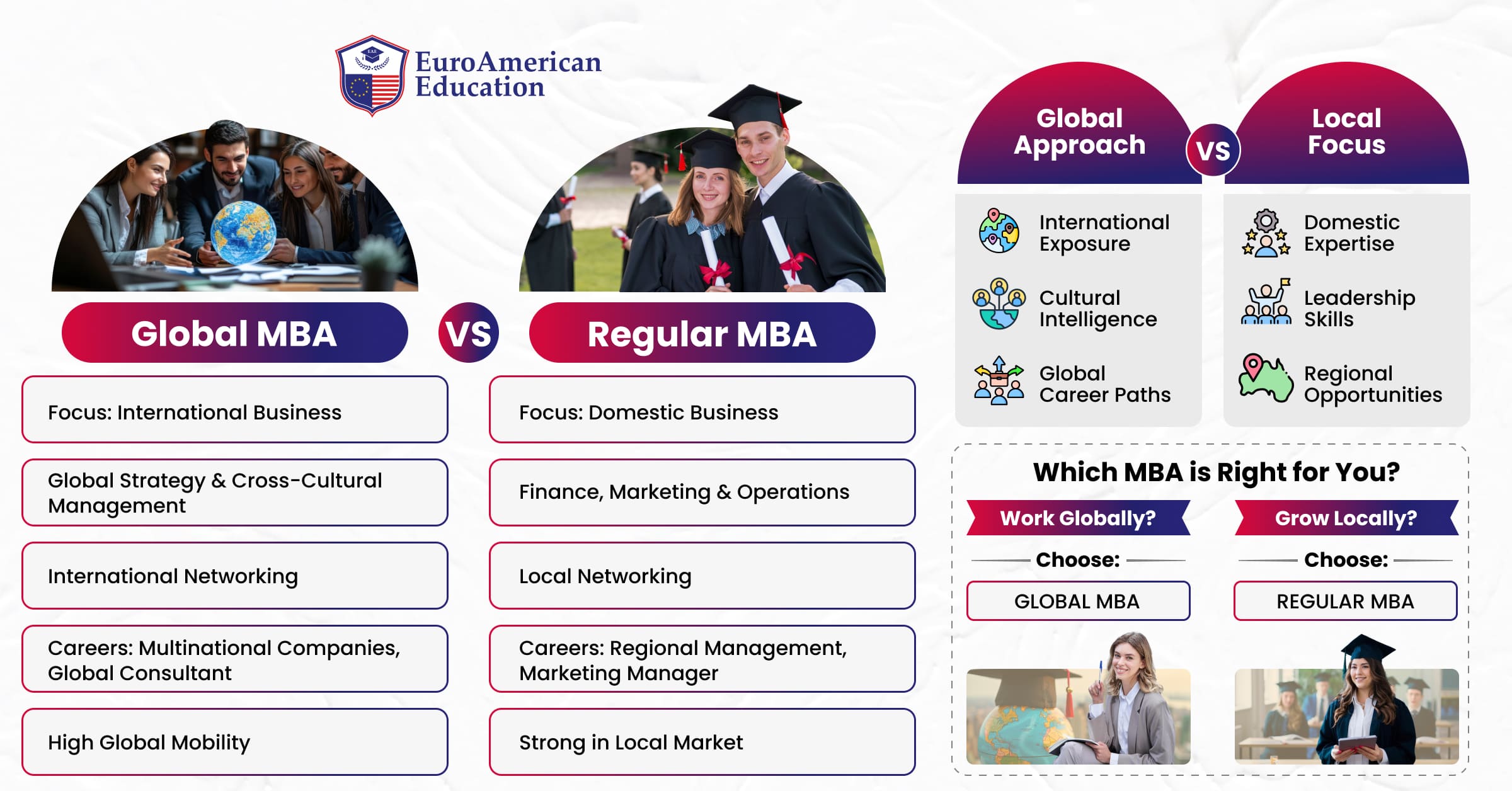
Please find a clear comparison table summarizing the major distinctions:
|
Aspect |
Global MBA |
Traditional MBA |
|
Primary Focus |
International business and global markets |
General business management and domestic markets |
|
Curriculum Scope |
Includes global strategy, international finance, cross-cultural management |
Covers finance, marketing, operations, leadership fundamentals |
|
Exposure |
Strong international exposure through multicultural teams and global projects |
Mostly local or national exposure |
|
Networking |
Diverse global cohort and international connections |
Mainly domestic professional network |
|
Career Path |
Multinational corporations, international consulting, global finance roles |
Local companies, regional management, industry leadership |
|
Mindset Developed |
Strategic global thinking and cultural intelligence |
Broad managerial competence and operational skills |
|
Mobility |
High global career mobility |
Typically stronger in domestic job markets |
From the comparison shown above, it can be concluded that the choice is less about quality and more about career direction and geographic ambition.
Which MBA Should You Choose?
Final decision depends on the following three important considerations:
- Career Geography
- If you aspire to work globally → opt for Global MBA
- If you aspire to work in the domestic market and lead globally → opt for Traditional MBA
- Professional Experience
- Professionals seeking to work for multinationals will benefit more from a Global MBA.
- Early-career professionals looking to learn about the broad business ecosystem may choose a Traditional MBA.
- Personal Learning Preference
If you are interested in multicultural environments and study global cases → go for Global MBA
If you are inclined towards learning the basics of business in a structured manner → go for Traditional MBA
Conclusion
Select the MBA that aligns with your career goals. If your goal is to work globally, manage global teams, or compete in the global marketplace, then pursue a Global MBA. If you have an inclination towards gaining general management skill set for leadership in various industries or within a domestic organization, then select a Traditional MBA. Evaluate your long-term goals, mobility, and interests, and then apply with purpose and begin creating your experiences that will support your desired path from this moment forward.

Frequently Asked Questions
Blogs and Articles
- Sep 29, 2026
- Management
Top Online DBA Specialisations: Utility, Benefits, and Global Salary Benchmarks
- Explore the top online DBA specialisations, their benefits and career scope, with global salary benchmarks to help professionals choose the right doctoral path.


- Sep 28, 2026
- Management

- Sep 12, 2026
- Technology

- Sep 11, 2026
- Technology