

 UAE
UAE

 United Kingdom
 Switzerland
 United States

















 Italy
Italy France
 India
India UAE
UAE Germany
 Russia
 Malaysia
 Spain
Spain United States
 Malta
Malta
How a Doctorate in Computer Science Can Lead to AI Leadership Positions
How a Doctorate in Computer Science Can Lead to AI Leadership Positions
The adoption of artificial intelligence is increasing quite fast across industries. Organizations are investing quite aggressively in machine learning, automation, and data-driven solutions. As the systems grow, there is a need for leaders in the AI field who are familiar with both AI models and the computing systems that support them.
According to the U.S. Bureau of Labor Statistics, the computer and information research scientist occupation is projected to grow by 26% by 2033, showing high demand for advanced computing skills. A Doctorate in Computer Science helps develop extensive expertise in algorithms, system design, data processing, and analytical skills. The program also helps develop skills to analyze complex problems, test solutions, and support decisions with evidence.
Doctoral work builds system-level thinking and problem-solving, providing a strong pathway to roles that redefine product strategy, research direction, and long-term innovation in AI.
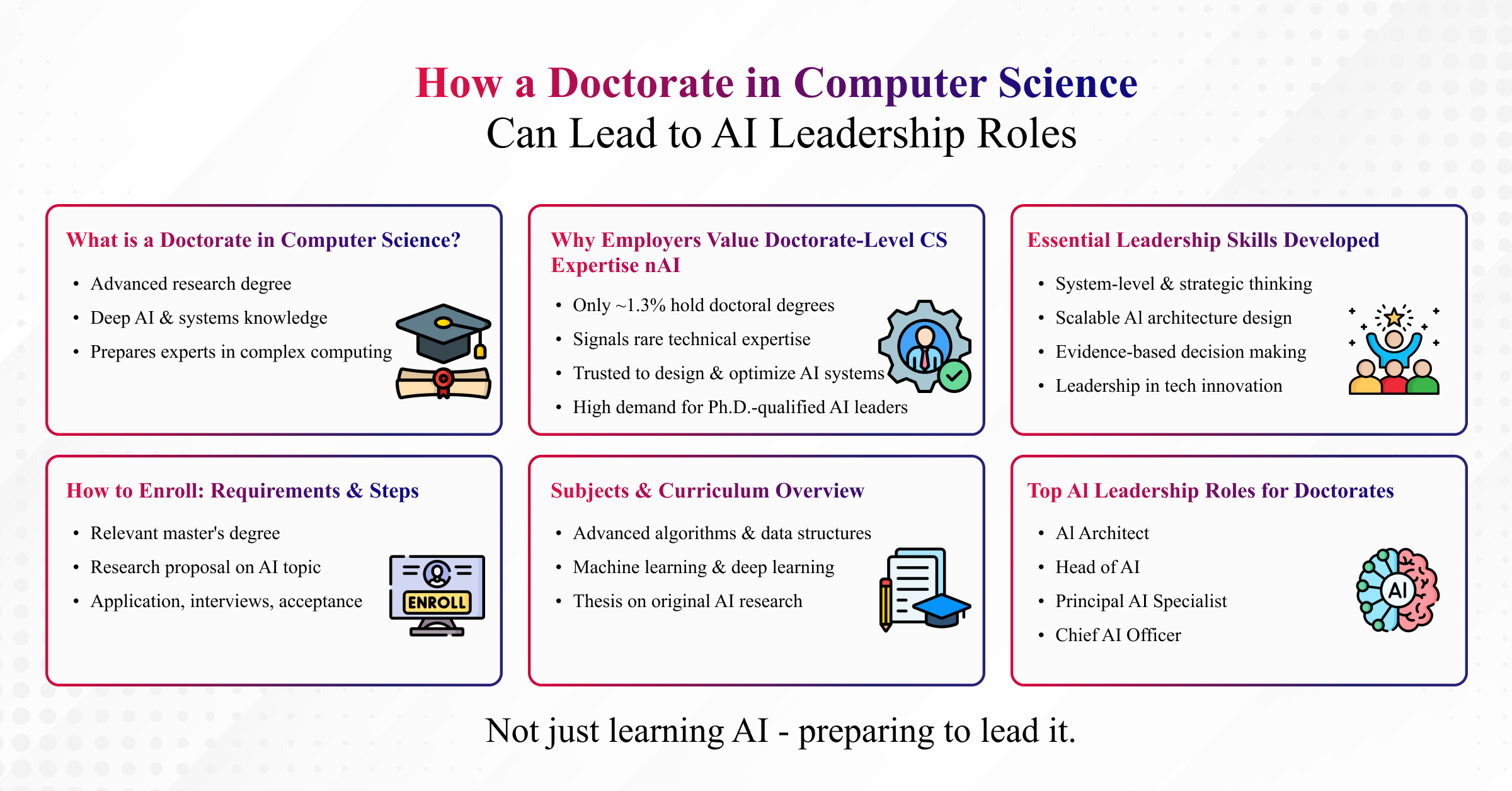
What is a Doctorate in Computer Science?
A Doctorate in Computer Science is the highest level of academic achievement in the field of computer science. This course is intended for those learners and professionals who are inclined to obtain deeper, expert-level knowledge in software systems, AI, data infrastructure, and complex computing technologies.
The course typically involves the following three aspects:
-
Advanced coursework in various specializations of computer science
-
Training in research to develop analytical and research skills
-
Doctoral thesis or applied project to demonstrate independent expertise
The program usually takes 3-5 years to complete, and it can be pursued — full-time, part-time, online, or in a hybrid format. Unlike other postgraduate courses, a doctoral degree focuses on long-term problem-solving and system design. Students are trained to — analyze, develop, and enhance existing technologies. This program is ideal for those who are interested in advanced technical roles, AI leadership positions, consulting work, and innovation-focused careers.
Why Employers Value Doctorate-Level Computer Science Expertise in AI
Organizations are in search of leaders who can assess complex systems and provide sound technical decisions. A Doctorate in Computer Science develops this skill by providing in-depth practical knowledge in algorithms, system design, and large-scale data systems. The skill set of a doctorate holder is quite scarce, as only 1.3% of the adult population in OECD nations possess a doctoral-level qualification, making it a strong signal in the job market for technical talent.
Employment statistics also reveal high demand for doctorate-level skills. Research indicates that over 70% of doctorate holders are employed in professional services and unemployment rates are generally low (about 1%), which is a strong indicator of high employability.
In production AI environments, leaders often face challenges in terms of accuracy, cost, reliability, security, and scalability. Doctorate holders possess the skill set to evaluate these factors, identify potential risks early, and apply research to make appropriate engineering-level decisions. For employers, an employee possessing a doctorate credential signals rare expertise and the ability to lead complex AI projects from research to reliable deployment.
Essential Leadership Skills Developed in a Doctorate in Computer Science
AI leadership requires judgement, clarity, and structured decision-making. A doctorate in computer science prepares you with these skills. It is done through constant exposure to complex technical problems.
Students are able to analyze failures, improve solutions, and explain decisions using data. This builds resilience and confidence during uncertain situations. They also acquire autonomy in problem-solving by designing investigations and managing long-term technical work.
A doctorate degree enhances your decision-making capability in the following areas:
-
model accuracy and validation
-
system reliability and safety
-
scalability in production
-
balance between performance and cost
A leader with a doctorate in computer science is able to break-down problems into milestones, focus on high-impact experiments, influence engineering, and effectively communicate technical decisions to others. This makes them ideal for senior AI leadership positions.
Decision-Making Skills for High-Risk AI Systems
AI systems are used in critical domains like cybersecurity, healthcare, finance, and automated decision systems. They can impact safety, regulatory compliance, and revenue. Managers need to handle problems calmly and methodically.
The Doctorate in Computer Science helps professionals to:
-
analyze failures without speculation
-
lead improvement plans systematically
-
trade off performance, CPU usage, reliability, and timelines
-
set priorities for solutions based on evidence
Example: Dealing with a drop in production model accuracy
When a production model suddenly stops being accurate after new data is introduced, a doctorate-trained leader will typically:
-
conduct error analysis before rollback
-
allocate compute resources to specific validation tests
-
keep developing in parallel while trying to figure out what's going wrong
-
record findings to avoid repeating mistakes
Such a systematic process helps avoid delays, keeps everyone on track, and allows the system to be trusted. Strong decision-making under adverse conditions is one of the most important skills that can be achieved through a Doctorate in Computer Science.
How to Enrol in a Doctorate in Computer Science: General Requirements and Application Steps
Scholars seeking a Doctorate in Computer Science should prepare for both academic eligibility and an organized admission procedure. Though specific requirements differ among institutions, most follow same pattern:
Basic Eligibility Requirements
Applicants generally need:
-
a Master's degree in Computer Science or a related field
-
(some universities consider a strong Bachelor's degree with relevant experience also for admissions)
-
a good foundation in programming, algorithms, and system design
-
knowledge of mathematics, statistics, or data analysis principles
Professional experience in software in IT, data science, or AI can be an added advantage, especially for professionally oriented doctorate programs.
Documents Generally Required
Most universities require:
-
academic transcripts and degree certificates
-
up-to-date CV with technical or research based experience
-
statement of purpose describing academic goals and specialization of interest
-
research proposal or topic outline (for some programs)
-
letters of recommendation from academic or professional contacts
-
Some universities may also require an interview to evaluate suitability for doctoral studies.
General Information Regarding Application Procedure
-
Choose your specialization area
Decide whether you are interested in AI, data systems, cybersecurity, software engineering, or other areas of computing.
-
Formulate a clear study or research interest
Even for course-based doctorates, universities need a specific area of interest.
-
Apply and send your documents
Apply online through the university portal before the intake closes.
-
Go for interview or further assessment (if applicable)
This could be a discussion about your background, technical interests, and long-term career objectives.
-
Receive admission and confirm enrolment
After acceptance of the offer, you need to complete the fee payment, registration, and orientation steps.
Subjects and Curriculum in a Doctorate in Computer Science
The curriculum for a Doctorate in Computer Science involves advanced technical education and research methodology and specialization.
Core Computing Foundations
Doctorate scholars will work on:
-
advanced algorithms and computational complexity
-
distributed and cloud computing systems
-
advanced database architecture
-
secure software and system design
AI and Data Technologies
You will learn about:
-
machine learning systems and model evaluation
-
AI deployment and management
-
data engineering and large-scale processing
-
optimization and performance analysis
Research and Innovation Skills
Doctoral program also covers:
-
research design and experimental methods
-
data analysis and validation techniques
-
technical writing and documentation
-
ethical and responsible technology practices
Doctoral Thesis or Applied Project
The final phase of the doctoral program in computer science will involve completing a major research project or applied solution. The project will assess a candidate's capability to identify a complex problem, develop a systematic solution, validate the findings, and communicate the results effectively.
This combination of technical depth and independent research prepares graduates for advanced computing roles and AI leadership responsibilities.
Is a Doctorate in Computer Science Worth the Investment?
Doctorate in Computer Science is an intensive degree program where you have to give your time, effort, and investment. However, its return can be very valuable for those professionals who are aiming for high technical authority or leadership positions.
The program may offer:
-
greater expertise than most master's programs
-
greater credibility for senior engineering or AI strategy positions
-
eligibility for research, consulting, or academic positions
-
long-term differentiation in competitive technology markets
ROI for the course may vary depending on the career objectives. For junior software positions, a doctorate may not be required. For system architecture, AI leadership, innovation strategy, or advanced research direction positions, the program may provide access to opportunities that are hard to attain otherwise.
Those professionals who possess advanced doctoral knowledge and have experience with real-world execution often move into high-impact positions that define — product strategy, technology adoption, and organizational decision-making.
Top AI Leadership Roles for Doctorate in Computer Science Graduates
Here are some top roles you can consider after completion of doctorate program in computer science:
-
Machine Learning Engineer/AI Engineer: generally $110,000-$160,000+ per year (in the U.S.), depending on experience and the company.
-
AI Architect/Artificial Intelligence Architect: approximately $128,756 per year (average in the U.S.).
-
AI Solutions Architect: approximately $145,963 per year (average in the U.S.).
-
Principal AI Architect/Lead AI Specialist: approximately $171,382 per year (average in the U.S.).
-
Head of AI/Director of Artificial Intelligence: usually $180,000-$250,000+ per year, depending on the company and size.
-
Chief AI Officer/CTO (AI-specialized): usually $220,000-$300,000+ per year, especially in large corporations or successful tech companies.
Undergoing a Doctorate program can help you advance a career into these positions through in-depth system understanding, analytical insight, and the authority to make high-impact AI strategy and engineering decisions.
Top Doctorate Specializations and Research Tracks in Computer Science and Engineering
Doctoral programs in Computer Science and Engineering provide specialized tracks that match the demand for technology and innovation in research. Selecting the right area of specialization can help in building the right expertise for a career in AI leadership, advanced engineering, or research.
Artificial Intelligence and Data Technologies
- Artificial Intelligence and Machine Learning
- Natural Language Processing
- Computer Vision
- Reinforcement Learning
- Data Science and Big Data Analytics
- Explainable & Responsible AI
Systems, Software, and Infrastructure
- Distributed Systems & Cloud Computing
- Software Engineering & System Architecture
- High-Performance Computing
- Edge Computing & Internet of Things (IoT)
- Network & Communication Systems
Security, Robotics, and Applied Computing
- Cybersecurity & Secure Computing
- Data Privacy & Cryptography
- Robotics & Autonomous Systems
- Human-Computer Interaction
- Graphics, Visualization & Virtual/Augmented Reality
Emerging and Advanced Fields
- Quantum Computing
- Blockchain & Decentralized Systems
- Computational Biology & Bioinformatics
- Digital Twin Technologies
- AI for Healthcare Informatics
Credible Doctorate in Computer Science Programs You Can Consider
Here is a list of accredited doctorate-level programs in Computer Science globally:
Professional/Applied Doctorates (often online or hybrid mode)
- Doctor of Computer Science (DCS) — Westcliffe University (Online/Hybrid)
- Doctor of Computer Science — Colorado Technical University (Online)
- Doctorate in Computer Science — EIMT Switzerland (Online)
- Doctor of Science in Cybersecurity/Computing — Capitol Technology University (Online/Hybrid)
- Doctor of Computing — The Open University (UK) (Distance/Hybrid research)
Research-Focused Doctorate-Level Computing Degrees (on-campus or research-based)
- Doctor of Science in Computer Science — Boston University (On-campus)
- Doctor of Science in Computer Science — Towson University (On-campus)
- Doctor of Science in Engineering (Computer Science focus available) — George Washington University (On-campus)
- Doctor of Engineering in Computer Science — Johns Hopkins University (Hybrid)
- Doctorate in Computing/Computer Science — University of Hertfordshire (Research/Hybrid)
- Doctor of Science in Computing — University of Fairfax (Online)
Additional Recognized Doctorate-Level Computing/CS Options
- Doctor of Professional Studies in Computing/Information Technology — Pace University (Hybrid)
- Doctor of Science in Information Systems (computing-intensive doctorate) — Robert Morris University (Hybrid)
- Doctor of Science (CS eligible field) — Banaras Hindu University (On-campus research doctorate)
Cost of a Doctorate in Computer Science Program
The tuition fee for a Doctorate in Computer Science program may vary from one university to another, depending on the country and mode of study. In some public universities, the tuition fee may range from $10,000 to $25,000 per year, while in private universities or professional doctorate programs, the tuition fee may range from $20,000 to $60,000 or more. Some research-based programs may offer full or partial funding, including tuition fees and a stipend in the form of scholarships, assistantships, or research grants. Online part-time programs for working professionals may also offer flexible payment options or employer sponsorship.
Read Also: Terminal Degree Debate: D.Sc. vs Ph.D. in Modern Scholarship
Common Funding Options for a Doctorate in Computer Science
Scholars pursuing a Doctorate in Computer Science can fund their studies effectively through a variety of academic and professional avenues:
- University scholarships and fellowships: These are merit-based awards that may pay for partial or full tuition and, in some cases, include a stipend.
- Research or teaching assistantships: These are paid positions that involve working with faculty members on research or teaching, and often include tuition remission and a monthly salary.
- Government research grants: These are national science organizations and research councils that fund doctoral study in computing and STEM disciplines.
- Employer sponsorship: Some professionals may be reimbursed for tuition, granted study leave, or receive project funding from their organizations.
- Scholarships and international programs: These are foundations and international programs that may pay for tuition, living expenses, travel, or conference attendance.
- Education loans and payment plans: Universities provide payment plans, and students can also seek postgraduate study loans when needed.
Prestigious Scholarships for Doctorate in Computer Science
|
Scholarship |
Benefit (approx.) |
Region |
Notes |
|
NSF GRFP |
$37k stipend + $16k tuition allowance |
USA |
Citizens/PR only |
|
DOE CSGF |
Full tuition + ~$45k stipend |
USA |
Computational science focus |
|
DoD NDSEG |
Full tuition + ~$40k stipend |
USA |
Citizens only |
|
MSCA Doctoral Networks (Horizon Europe) |
~€3.3k/month + allowances |
Europe/International |
Apply to positions, not central pool |
|
Vanier CGS |
$50k/year |
Canada |
Nomination required |
|
DAAD Doctoral Funding |
~€1.3k/month + extras |
Germany |
Many program types |
|
CSC Scholarship |
Tuition + stipend + housing |
China |
Prestige varies |
|
A*STAR Graduate Scholarships |
Fully funded + stipend |
Singapore |
Often includes work bond |
These competitive scholarships often give full coverage to the student's expenses such as tuition, living, travel, and research, thus making it possible for computer science doctoral students to concentrate on advanced research and innovation.
How Long Does a Doctorate in Computer Science Take?
You can complete a Doctorate in Computer Science program in 3 to 5 years. This depends on the mode of study and the scope of your research. Please find the breakdown of duration for a doctorate program:
- Coursework phase: 1-2 years, this phase involves learning advanced topics and research techniques.
- Research phase: 1-3 years, in this phase you will be conducting research, experimenting, and developing.
- Writing, assessing, and defending the thesis or final project: this is a part of the research phase.
Online and hybrid programs follow similar timelines but allow more scheduling flexibility.
What Does a Day in the Life of a Computer Science Doctorate Student Look Like?
- Research and reading: Research papers, data analysis, or examination of new technical approaches.
- Coding and experimentation: Algorithm development, model testing, simulation, or system debugging.
- Supervisor or team interaction: Virtual or physical meetings to discuss research progress and plans.
- Coursework or teaching support: Online or physical attendance at advanced lectures, or support for labs and student inquiries.
- Writing and documentation: Research note updates, report writing, or thesis chapter composition.
- Seminars and collaboration: Webinars, workshops, or research group meetings.
- Planning and problem-solving: Experiment design, outcome analysis, and setting short-term research objectives.
While schedules are dependent on the study mode, most doctorate scholars balance their research, technical development work, collaboration, and educational commitments.
Read Also: Doctor of Science (D.Sc. or Sc.D.) Degree: An Overview
Comparison Between Doctorate in Computer Science vs PhD in Computer Science
Students often wonder if a Doctorate in Computer Science is the same as a PhD. Both are doctoral degrees, but their emphasis can differ depending on the institution.
|
Doctorate in Computer Science |
PhD in Computer Science |
|
Often comprises structured coursework first |
Usually research-focused from the beginning |
|
Can emphasize applied or professional outcomes |
Emphasizes original academic research |
|
Suitable for industry leadership and advanced practice |
Commonly chosen for academic or research careers |
|
May allow flexible study for professionals |
Typically full-time research intensive |
|
Thesis may focus on applied technical solutions |
Dissertation focuses on theoretical contribution |
If your goal is to manage engineering teams, control AI systems, or manage an industry, a Doctorate in Computer Science will be very beneficial. If your aim is to conduct research at a university or teach at a university, then a PhD is often preferred.

Frequently Asked Questions
Blogs and Articles
- Sep 14, 2026
- Management
Online DBA: EIMT vs SIMA vs Dunster vs Geneva Business School
- Compare EIMT, SIMA, Dunster, and Geneva Business School to understand key differences in online DBA programs, including study format, flexibility, duration, fees, accreditation, and career value.

- Sep 12, 2026
- Technology

- Sep 11, 2026
- Technology

- Aug 28, 2026
- Technology