

 UAE
UAE
 United Kingdom
 Switzerland
 United States











 Italy
Italy France
 India
India UAE
UAE Germany
 Russia
 Malaysia
 Spain
Spain United States
 Malta
Malta
Top 20 Open Source AI Agent Frameworks Compared (2026)
Top 20 Open Source AI Agent Frameworks Compared (2026)
State of Agentic Engineering in 2026
Production agent work has moved past prompt chaining. LangChain's 2026 State of Agent Engineering research found 57% of organizations now run agents in production, with output quality — not cost — cited as the main barrier. That shift shows up in which frameworks are consolidating around durable state and which are quietly being deprecated by their own maintainers.
The comparison skips GitHub stars as a quality signal and evaluates on four axes: state determinism (typed, checkpointed state versus implicit conversation history), loop and cost control (built-in step limits versus open-ended agent chatter), debuggability (clean stack traces versus buried framework internals), and ecosystem fit (OpenTelemetry/LangSmith support versus closed platforms).
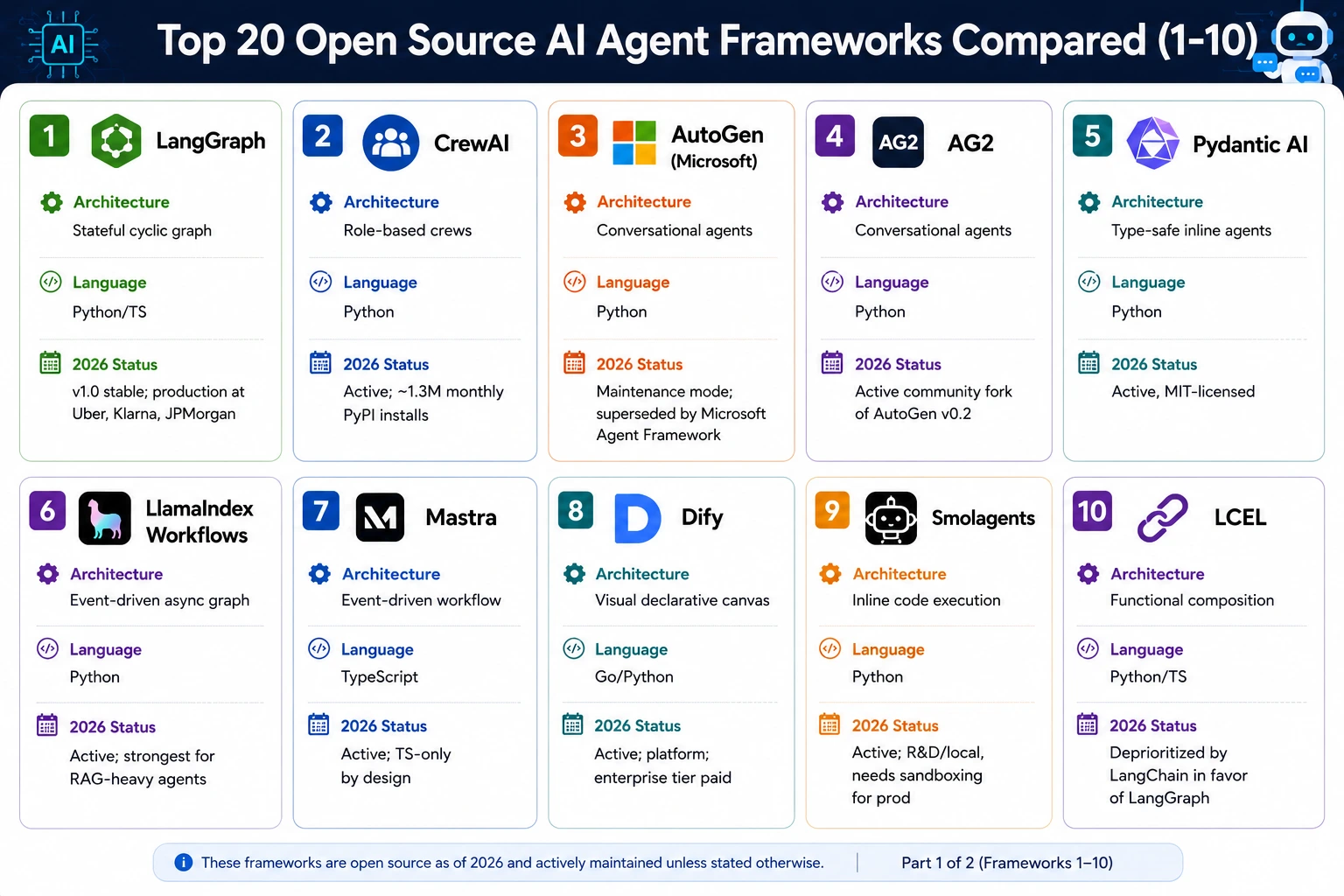
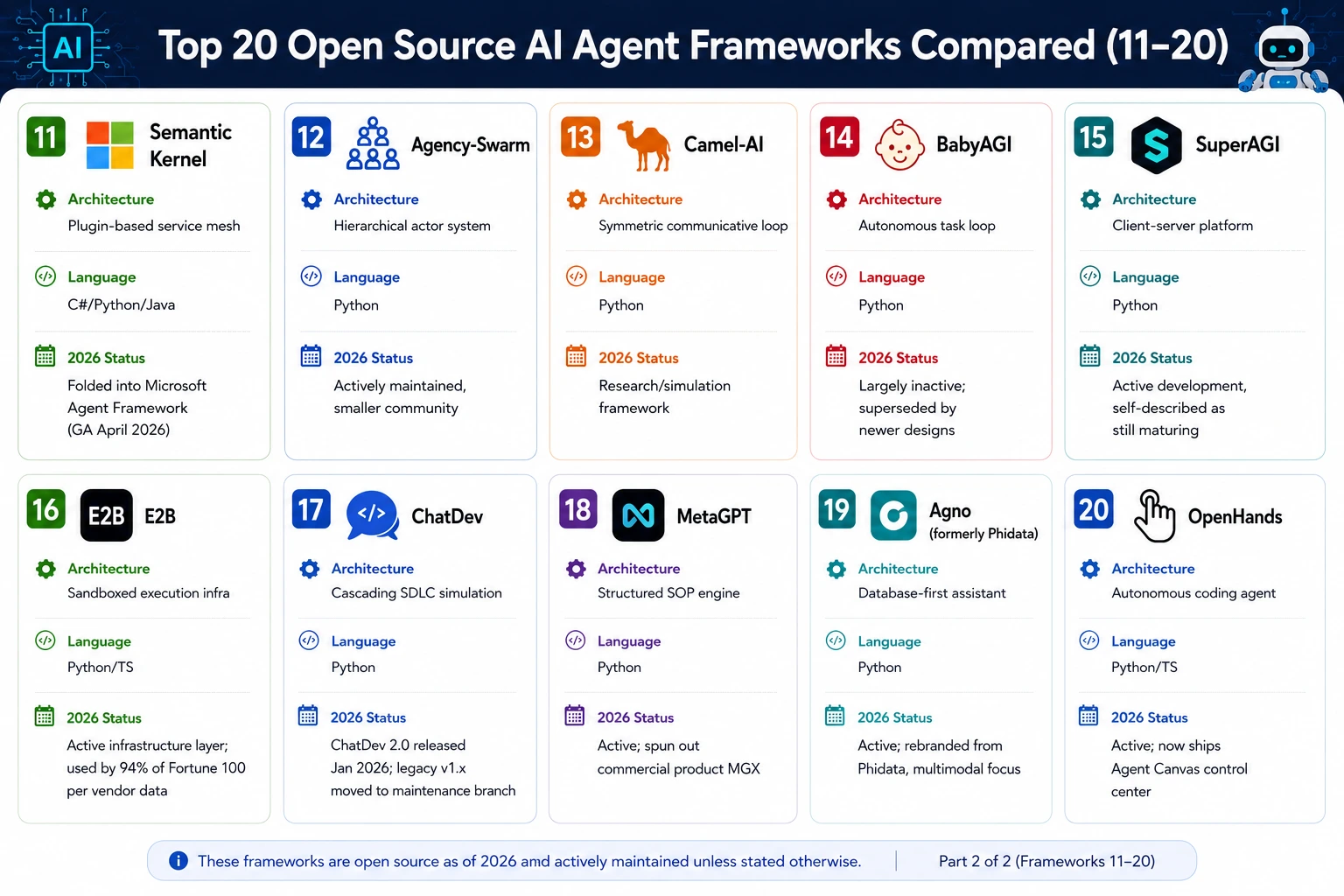
Comparison Matrix: Top Open Source AI Agent Frameworks
Category 1: Production-Grade Stateful Graphs
- LangGraph remains the reference point here: a typed state schema, node functions, conditional edges, and Postgres/SQLite checkpointers that let an agent pause for human review or resume after a crash. LangChain's own documentation and 2026 v1.0 announcement cite production use at Uber, LinkedIn, JPMorgan, and Klarna, including an 80% reduction in customer resolution time at Klarna. The tradeoff is: modifying live graph topology can ripple across dependent nodes, and async stack traces often bury the real error inside framework internals.
- LlamaIndex Workflows: takes the same event-driven-graph philosophy but optimizes for document-heavy, retrieval-grounded agents. Multiple 2026 comparisons (Cordum, Turion.AI) independently rank it as the strongest choice when an agent's core job is querying a private knowledge base rather than general orchestration. Its indexing and parsing primitives are more mature than its multi-agent routing. Hence, teams often pair it with LangGraph for the orchestration layer.
- Mastra: brings the same durable-workflow philosophy to TypeScript, with explicit branching, parallel execution, and pause-for-approval steps. A December 2025 developer-experience benchmark cited by NextBuild scored it 9/10 versus LangChain's 5/10 for JS-first teams, though it has no Python SDK by design.
- Microsoft Agent Framework (the April 2026 GA unification of Semantic Kernel and AutoGen): features here too for Azure-native teams — it adds graph-based workflows on top of Semantic Kernel's plugin model, with Python and .NET parity and built-in Azure AI Foundry observability.
Category 2: Role-Based and Conversational Multi-Agent Systems
- CrewAI: structures work as a "crew" of role-playing agents with a task list — the fastest route to a working-model based prototype, with roughly 1.3 million monthly PyPI installs per ZenML's 2026 data. However, its error handling operates on an all-or-nothing basis. While this approach works fine when a failed run is cheap to restart from scratch, the system struggles when a minor, partial failure requires a graceful recovery instead of a complete reset.
- AutoGen vs. AG2: needs a direct correction from how older comparisons describe it. Microsoft has removed the original AutoGen repository into maintenance mode and now directs new users to Microsoft Agent Framework instead. AG2, the community fork under the ag2ai GitHub organization, is the actively developed continuation of the original conversational model — pick AG2, not Microsoft's AutoGen repo, for new work.
- Camel-AI and Baby AGI are the research-lineage frameworks in this category. Camel's role-playing communicative-agent approach remains active mainly in academic and simulation contexts; BabyAGI's original autonomous task-loop design is now largely superseded and sees limited active maintenance, though it's still referenced as the conceptual ancestor of most autonomous-loop agents that followed it.
- Agency-Swarm: applies a hierarchical, agency-of-agents structure with tighter communication boundaries than open GroupChat patterns, but runs a smaller community than CrewAI or AG2, so third-party integrations and troubleshooting resources are harder to find.
Category 3: Type-Safe, Code-First Architectures
- Pydantic AI: lets developers build agents using normal Python code and standard variables instead of forcing them into a complex, rigid workflow engine. It tracks and checks data structure changes in real time. Industry evaluations by firms like Alice Labs and Cordum consistently recommend it for Python teams who want a clean, familiar setup similar to FastAPI.
- Smolagents: lets AI agents run their own generated code directly instead of guessing what to do with standard text data. While this approach is great for technical research, using it in production is risky. You must set up and manage your own secure digital testing environments — like Docker or Firecracker — to prevent the AI from running harmful code on your servers.
- Agno (formerly Phidata): is a lightweight, easy-to-use framework designed for multimodal, high-speed agent teams handling text, images, and audio. For safety, developers usually pair it with outside cloud platforms like E2B or Modal to run any code the AI creates inside a secure sandbox.
- LCEL (LangChain Expression Language): It is an older method for linking multiple AI tasks together in a single chain. While it still works for basic, step-by-step tasks, LangChain's official guides now recommend avoiding it for new projects. You should treat it as outdated technology and use LangGraph instead for complex workflows.
Category 4: Infrastructure and Coding-Agent Platforms
- E2B: provides highly secure digital "sandboxes" specifically designed to run unpredictable code created by AI. The company claims that 94% of Fortune 100 companies use their technology, including major AI brands like Hugging Face and Perplexity. It's not an AI framework by itself; rather, it is the secure background infrastructure that powers other popular tools like Agno, OpenAI Agents SDK, and OpenHands.
- OpenHands: a specialized framework that is built entirely for autonomous coding agents. It features an interactive control center called Agent Canvas that lets you run and monitor OpenHands, Claude Code, or other standard coding tools. You can easily host it yourself and run it on your local computer, a private virtual machine, or the cloud.
- ChatDev: acts like a virtual software company where different AI agents roleplay as the CEO, CTO, programmers, and testers to build apps together. In January 2026, the project launched ChatDev 2.0, which completely changed how it works by introducing a visual, zero-code platform to manage these agents. The original step-by-step coding version is now kept separate as an older, legacy model.
- MetaGPT: also uses the "software company" setup, but it forces agents to follow strict, professional business guidelines rather than letting them chat freely. The creators have turned this framework into a paid commercial product called MGX, though the original free, open-source version is still active and supported.
Category 5: Low-Code and Visual Platforms
- Dify: provides a visual drag-and-drop screen that turns your layouts into working database entries and background tasks. This is incredibly helpful for teams where non-technical staff need to change how an AI behaves. However, you will hit a wall if your project requires highly complex repetition or specialized tools that the visual screen does not support.
- SuperAGI: offers a complete visual platform with a dashboard, an action monitor, and several choices for data storage. While it looks complete, its own code page lists it as still experimental with many unsolved bugs. You should think twice before using it to power a critical business system right now.
How Each Framework Scores
Based on the facts above, we have given all 20 frameworks a score from 1 to 5 across four key areas: State Management, Loops/Cost Control, Debuggability, and Ecosystem Fit. A score of 5 just means a framework is excellent at that one specific job, not that it is the best tool overall. For example, Smolagents might get a low score for controlling costs and loops, but it could still be the perfect choice if you just want a simple, code-focused setup.
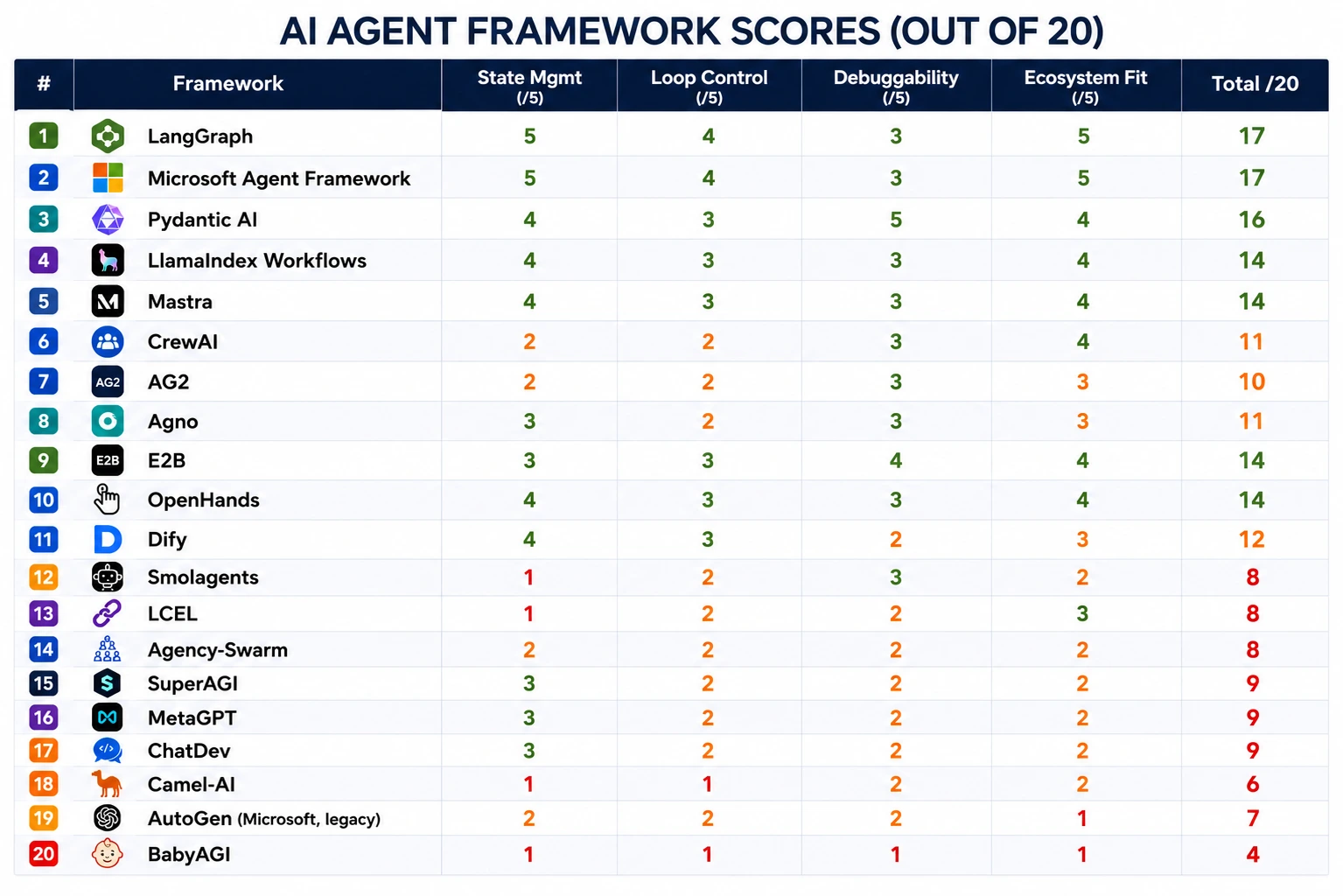
Reasoning behind the top and bottom of each column (one line per axis, so the scores read as judgment, not just numbers):
- State Management: LangGraph and Microsoft Agent Framework lead because both save progress to outside databases like Postgres or Azure. If the system crashes, it can restart exactly where it left off. BabyAGI and Camel score the lowest because they save the data in temporary memory. So, if the system goes down, all progress is permanently lost.
- Loop/Cost Control: Pydantic AI and LlamaIndex score well because they use normal code like "if/else" statements to stop the AI naturally. CrewAI and AG2 score lower because their agents pass tasks back and forth in open-ended conversations. This can cause the AI to run in circles and burn money unless you manually set up a strict limit.
- Debuggability: Pydantic AI is the winner here because when data breaks, it immediately throws a standard Python error right where it happened. Graph-based frameworks lose points because when a specific part fails, the error gets buried deep inside the framework's own complicated background code, making it hard to find.
- Ecosystem Fit: LangGraph and Microsoft Agent Framework score highest because they connect perfectly with major monitoring tools such as LangSmith or Azure AI. Legacy AutoGen scores the lowest because Microsoft's own page tells developers to stop using it, meaning its tools are outdated and no longer supported.
Note: Scoring is based independently on verified facts rather than vendor marketing, reflecting the out-of-the-box functionality of the framework.
A Practical Selection Framework
Choose LangGraph for reliable, crash-proof systems in Python or TypeScript, as it is the most trusted tool by large companies. Opt for LlamaIndex Workflows if your agent's main job is searching through your own private data. Choose CrewAI to quickly build an early prototype where fixing mistakes is cheap.
Choose AG2 (the new version, not Microsoft's old AutoGen) if you need agents to debate and talk to each other. Choose Pydantic AI to plug clean, safe agent logic right into your current Python apps. Choose Mastra if your team work
Conclusion & The Future of Open Source Orchestration
The open-source AI agent landscape is moving decisively toward type safety, explicit determinism, and infrastructure-level isolation. Early implementations relied heavily on flexible, unconstrained conversational setups. However, production requirements have shifted engineering priorities toward frameworks that offer predictable performance, clear debugging data, and deterministic state management.
As teams scale these systems, the key differentiator will not be how quickly an agent can prototype a workflow, but how reliably it can execute that workflow thousands of times without failing. Choosing an architecture that aligns cleanly with your team's existing development stack and infrastructure limits is the best way to ensure production reliability.

Frequently Asked Questions
Blogs and Articles
- Sep 29, 2026
- Management
Top Online DBA Specialisations: Utility, Benefits, and Global Salary Benchmarks
- Explore the top online DBA specialisations, their benefits and career scope, with global salary benchmarks to help professionals choose the right doctoral path.

- Sep 28, 2026
- Management

- Sep 12, 2026
- Technology

- Sep 11, 2026
- Technology