

 UAE
UAE

 United Kingdom
 Switzerland
 United States

















 Italy
Italy France
 India
India UAE
UAE Germany
 Russia
 Malaysia
 Spain
Spain United States
 Malta
Malta
Cyber Security Jobs in Dubai and Abu Dhabi: Salaries and Future Demand
Cyber Security Jobs in Dubai and Abu Dhabi: Salaries and Future Demand
Why Dubai and Abu Dhabi Lead Cybersecurity Hiring? Cybersecurity careers in the UAE have moved from niche technical roles to one of the fastest-growing employment areas across the Middle East. Companies in Dubai and Abu Dhabi now compete aggressively to secure skilled professionals who can protect financial systems, government platforms, cloud infrastructure, and smart city networks.
Key Industry Facts:
- Recent hiring reports confirm how quickly demand has accelerated. Recruitment analysis published by Edoxi Training Institute shows cybersecurity hiring demand in Dubai increased by 60.59% across major job platforms such as LinkedIn, Glassdoor, and Indeed. This rise reflects sustained employer demand rather than temporary recruitment activity.
- The UAE offers one of the strongest financial advantages for technology professionals. Cybersecurity employees receive full salary earnings without personal income tax deductions.
- Dubai has already positioned itself as a regional cybersecurity employment center. Industry research from Nucamp reports more than 2,000 active cybersecurity job openings across sectors, including banking, aviation, fintech, healthcare, and government technology services.
- Growth extends well beyond Dubai. Abu Dhabi recorded 1,586 cybersecurity vacancies, representing nearly 16% of all cybersecurity job opportunities across the region, according to Edoxi hiring data. Market projections indicate continued expansion, with cybersecurity employment demand in Abu Dhabi expected to grow by an additional 15% by 2025 as government digitization and infrastructure modernization programs expand.
These numbers answer the question many professionals ask before changing careers or relocating: Is cybersecurity demand in the UAE stable enough to justify the move?
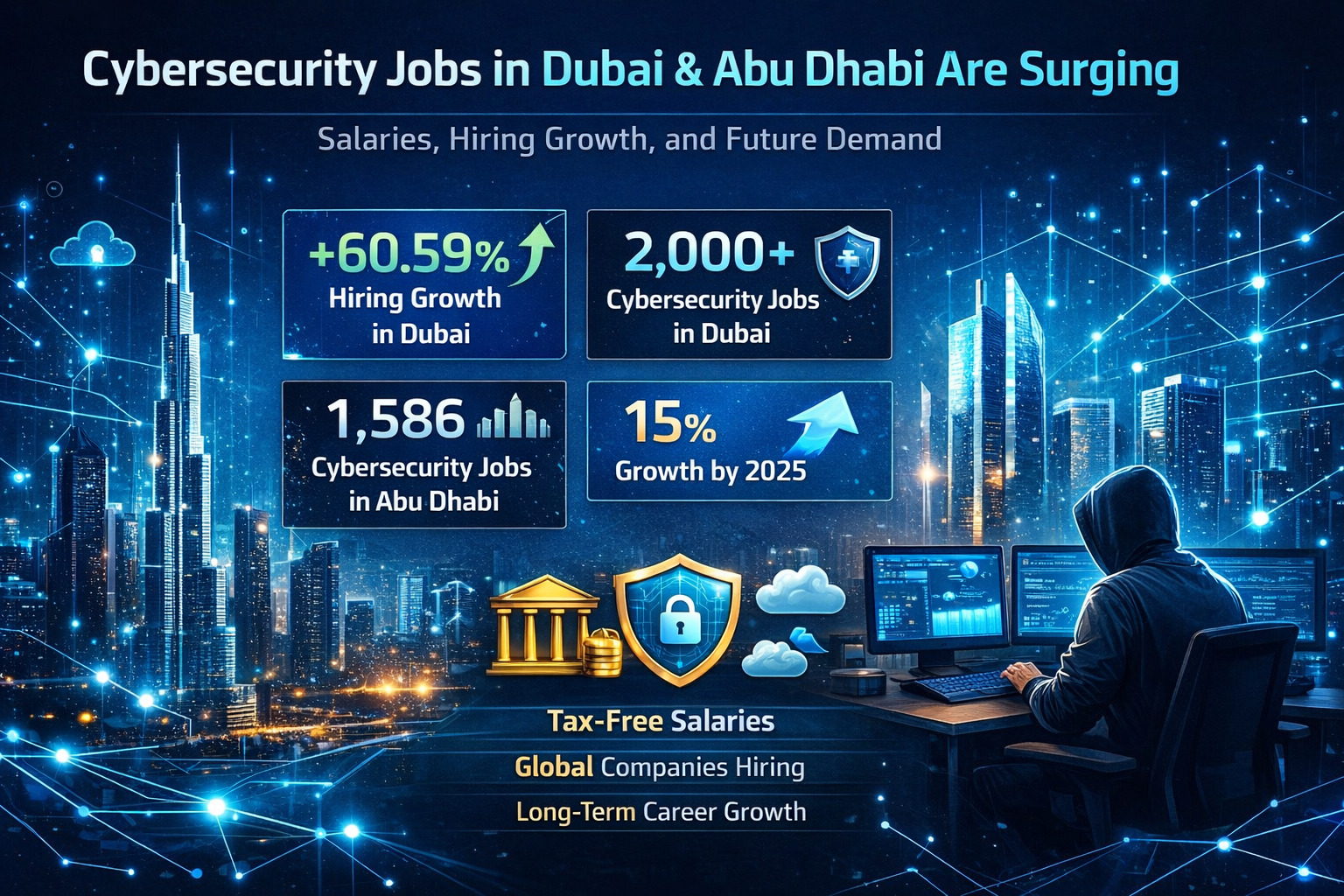
For job seekers, this trend signals more than the availability of roles. It points to sustained career growth, competitive salaries, and long-term employment opportunities in two cities that have become central hubs for cybersecurity talent in the Middle East.
Why Companies in the UAE Are Investing Heavily in Cybersecurity Teams
Cybersecurity hiring across the UAE continues rising because organizations face a combination of growing cyber threats, expanding technology infrastructure, and a global shortage of skilled professionals. Business and government institutions have started viewing cybersecurity as an IT support function. They treat it as a core operational requirement tied directly to business continuity and national security.
Increase in Cyberattacks Across UAE Systems
- Industry Analysis published by Cyber Magazine, UAE public sector systems experience around 50,000 cyberattack attempts every day. These attacks target government portals, financial systems, healthcare networks, and transportation infrastructure.
- Additional research released through Global Newswire reports that 87% of UAE organizations experienced at least one cybersecurity incident within a single year. The frequency of these incidents forces companies to move from reactive security measures toward permanent in-house cyber defense teams.
Rapid Expansion of Digital Infrastructure
The UAE government continues investing heavily in nationwide digital transformation programs designed to modernize public services and economic systems. These initiatives include:
- Transition toward fully digital government operations
- Development of sovereign cloud environments
- Deployment of smart city infrastructure
- Expansion of connected transportation and energy systems
Each new digital platform increases exposure to cyber risks. Protecting interconnected systems requires specialized cybersecurity professionals who can secure cloud environments, monitor infrastructure activity, and respond immediately to security incidents.
Talent Shortage Driving Aggressive Recruitment
Another major factor accelerating cybersecurity hiring involves the shortage of skilled professionals worldwide. Research from Nucamp indicates that about 90% of UAE companies struggle to find qualified cybersecurity talent.
This challenge aligns with global workforce data analyzed by Cyber Magazine, which estimates a global cybersecurity gap exceeding 4.8 million unfilled positions. Because demand exceeds available talent, employers across Dubai and Abu Dhabi have adjusted recruitment strategies. Companies now:
- Recruit professionals internationally
- Offer higher compensation packages
- Accelerate promotion timelines
- Sponsor relocation and visa programs
Industries Hiring Cybersecurity Professionals in the UAE
Multiple industries now compete for skilled professionals as cyber risks grow alongside large-scale technology adoption. Government modernization programs, cloud migration, and connected infrastructure continue to expand security teams across both Dubai and Abu Dhabi. This cross-industry demand directly pushes salaries upward and creates stable, long-term career opportunities.
Banking and Financial Services
Banks and fintech companies rank among the largest cybersecurity employers in the UAE. Digital payments in the country crossed AED 1 trillion in transaction value, according to the UAE Central Bank. Financial institutions hire specialists to protect:
- Online banking platforms
- Mobile payment systems
- Customer identity databases
- Fraud detection systems
Strict compliance rules, such as anti-money laundering regulations, force banks to maintain full-time security monitoring teams. Cybersecurity analysts, GR specialists, and threat intelligence professionals remain in constant demand.
Aviation and Transport
The UAE manages some of the world's busiest aviation hubs, including Dubai International Airport and Zayed International Airport. Airlines and airport systems depend on interconnected networks that control:
- Flight operations
- Passenger data systems
- Cargo logistics
- Air traffic communication
Any disruption creates operational and financial risk. Organizations therefore invest heavily in SOC analysts and network security engineers who monitor systems around the clock.
Government and Smart Cities
National digitization programs such as the UAE Digital Government Strategy 2025 expand cybersecurity hiring across ministries and public services. Smart city platforms manage:
- Traffic systems
- Public surveillance networks
- Digital identity services
- Municipal cloud infrastructure
Government entities build permanent internal cybersecurity teams instead of relying only on vendors. Demand remains strong for security architects, incident responders, and cyber risk managers.
Oil and Energy Sector
Energy companies operate critical industrial environments across Abu Dhabi and other emirates. Organizations such as Abu Dhabi National Oil Company depend on Operational Technology networks that control drilling, refining, and distribution systems.
Cyber attacks targeting industrial control systems increased globally, which drives hiring for:
- OT security specialists
- Industrial network defenders
- Threat monitoring engineers
Protection of energy infrastructure ranks as a national priority.
Healthcare Systems
Healthcare digitization expanded rapidly after nationwide electronic medical record adoption by the UAE Ministry of Health and Prevention. Hospitals are now secure:
- Patient health records
- Connected medical devices
- Telemedicine platforms
- Insurance databases
Healthcare data sells at high prices on cybercrime markets, which forces hospitals to recruit cybersecurity professionals focused on privacy protection and incident response.
Market Impact on Salaries
Competition among the banking, aviation, government, energy, and healthcare sectors creates aggressive hiring conditions. Organizations compete for the same limited talent pool, which results in:
- Faster salary growth
- Relocation incentives
- Leadership hiring expansion
- Long-term job stability
Top Cybersecurity Roles in Dubai and Abu Dhabi
Cybersecurity hiring across Dubai and Abu Dhabi covers multiple specialization levels, from entry-level monitoring roles to executive leadership positions. Employer demand reflects the need to secure banking systems, government infrastructure, cloud platforms, and enterprise networks operating across the UAE.
1. Cybersecurity Analyst
Cybersecurity Analysts represent the entry-level and mid-level backbone of security operations teams across UAE organizations. Companies rely on analysts to detect threats before they disrupt business operations.
Core Responsibilities
- Monitor network activity for suspicious behavior
- Analyze vulnerabilities across systems and applications
- Investigate security incidents and generate response reports
Hiring research conducted in Abu Dhabi identified more than 79 active cybersecurity analyst vacancies, confirming sustained demand for monitoring and incident investigation roles.
Average Salary: AED 12,900 to AED 18,000 per month based on UAE hiring reports published by Edoxi Training Institute.
2. Security Engineer
Security Engineers design and maintain the technical defenses that protect enterprise infrastructure. Organizations expanding cloud and hybrid environments actively recruit engineers capable of building secure systems from the ground up.
Core Responsibilities
- Configure firewalls and intrusion prevention systems
- Implement endpoint protection solutions
- Maintain infrastructure and network security architecture
Dubai hiring analysis recorded over 206 active security engineer openings, making this one of the most consistently advertised cybersecurity roles.
Average Salary: Starting salaries begin around AED 8,400 per month, according to market analysis from Nucamp.
3. SOC Analyst (Security Operations Center)
SOC Analysts operate inside centralized monitoring environments that track threats continuously. The high volume of cyberattack attempts targeting UAE systems requires companies to maintain round-the-clock security monitoring teams.
Core Responsibilities
- Perform continuous system monitoring
- Investigate security alerts
- Respond to potential breaches in real time
Daily attack activity across public and private infrastructure drives constant recruitment for SOC teams.
Average Salary: AED 9,000 to AED 21,000 per month based on Abu Dhabi cybersecurity hiring data from Edoxi Training Institute.
4. Penetration Tester / Ethical Hacker
Penetration testers simulate cyberattacks to expose weaknesses before malicious actors exploit them. Rising ransomware incidents across UAE industries have increased demand for proactive security testing.
Core Responsibilities
- Conduct controlled cyberattack simulations
- Identity system and application vulnerabilities
- Perform security validation testing
Organizations in finance, aviation, and government sectors prioritize ethical hacking assessments to meet compliance standards.
Average Salary: Senior professionals earn between AED 25,000 and AED 45,000 per month, according to UAE cybersecurity compensation studies referenced by Nucamp.
5. Cloud Security Specialist
Cloud adoption across UAE enterprises has created one of the fastest-growing cybersecurity specializations. Businesses migrating workloads to cloud environments require experts who can secure disturbed systems.
Core Responsibilities:
- Protect cloud workloads and storage environments
- Manage identity and access controls
- Design enterprise cloud defense strategies
Government sovereign cloud initiatives continue to increase the demand for cloud security professionals.
Average Salary: AED 30,000 to AED 60,000 per month based on regional cybersecurity salary benchmarks.
6. Cybersecurity Manager
Cybersecurity Managers oversee enterprise-level protection strategies and coordinate technical teams responsible for risk management and compliance.
Core Responsibilities
- Lead organizational security governance
- Manage regulatory and compliance requirements
- Direct enterprise risk management programs
Because experienced leadership talent remains limited, companies compete aggressively for professionals capable of managing large security operations.
Average Salary: AED 35,000 to AED 80,000 per month according to UAE hiring trend reports.
7. Chief Information Security Officer (CISO)
The Chief Information Security Officer represents the highest cybersecurity leadership role within large organizations and government entities.
Core Responsibilities
- Define an organization-wide cybersecurity strategy
- Ensure regulatory compliance and risk oversight
- Report cyber risk exposure to executive leadership
Large enterprises and financial institutions offer executive compensation packages reflecting the strategic importance of cybersecurity leadership.
Read Also: Top 10 Highest Paying Jobs in the World
Other Cybersecurity Job Roles in Dubai and Abu Dhabi
|
Cybersecurity Role |
Primary Responsibilities |
Average Salary (AED/Month) |
Demand Driver |
Source |
|
Threat Intelligence Analyst |
Analyze global threat patterns, monitor attacker tactics, and support proactive defense planning |
18,000 to 32,000 |
Growth in advanced cyber threats targeting enterprises |
Edoxi Training Institute |
|
Incident Response Specialist |
Manage live cyber incidents, contain breaches, and restore affected systems |
20,000 to 40,000 |
Rising ransomware and enterprise attack frequency |
Cyber Magazine |
|
Information Security Consultant |
Advise organizations on security strategy, compliance, and risk reduction |
22,000 to 45,000 |
Expanding regulatory compliance requirements |
Nucamp |
|
Governance, Risk & Compliance (GRC) Analyst |
Maintain policies, conduct audits, and manage regulatory cybersecurity standards |
15,000 to 35,000 |
Banking and financial sector regulations |
Robert Walters |
|
Application Security Engineer |
Secure applications during the software development lifecycle |
25,000 to 50,000 |
Fintech and SaaS platform expansion |
Cyber Magazine |
|
Network Security Engineer |
Protect enterprise networks, configure intrusion detection systems |
18,000 to 38,000 |
Hybrid cloud and enterprise networking growth |
Edoxi Training Institute |
|
Digital Forensics Analyst |
Investigate cybercrime evidence and breach activity |
20,000 to 42,000 |
Corporate and government cyber investigations |
Cyber Magazine |
|
Identity and Access Management (IAM) Specialist |
Manage authentication systems and access privileges |
22,000 to 45,000 |
Cloud adoption and remote workforce security |
Nucamp |
|
Malware Analyst |
Analyze malicious software and develop threat detection signatures |
25,000 to 48,000 |
Increase in advanced persistent threats |
SANS Institute |
|
OT Security Specialist (Operational Technology) |
Secure industrial control systems in the energy and infrastructure sectors |
30,000 to 60,000 |
Protection of oil, gas, and smart infrastructure |
International Energy Agency |
|
DevSecOps Engineer |
Integrate security controls into development and deployment pipelines |
28,000 to 55,000 |
Cloud-native and containerized application growth |
Cyber Magazine |
|
Security Automation Engineer |
Build automated detection and incident response systems |
30,000 to 58,000 |
Enterprise-scale monitoring requirements |
Cyber Magazine |
Core Technical Skills Required for Cybersecurity Jobs in the UAE
Hiring research reviewing 12,000+ cybersecurity job listings across UAE recruitment platforms shows a clear pattern in employer expectations. Companies prioritize professionals who can immediately support threat detection and enterprise protection.
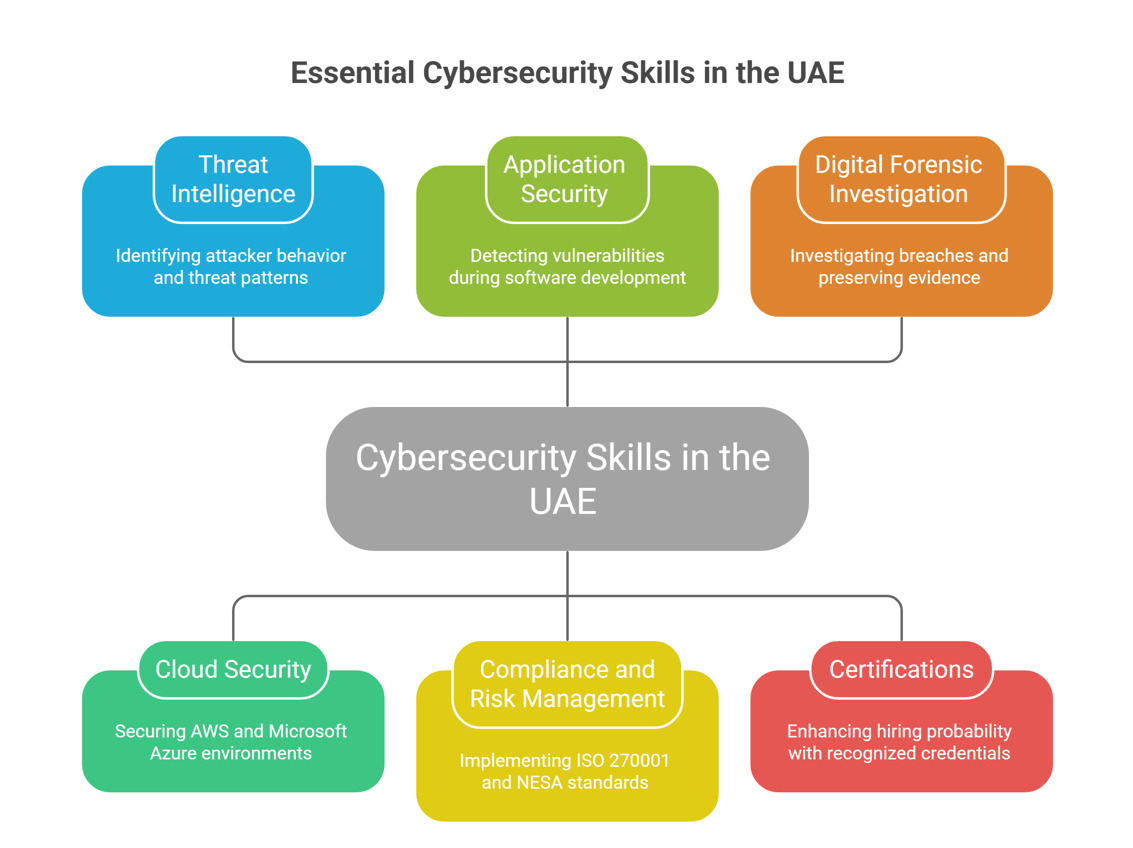
Threat Intelligence
- Identify attacker behavior and threat patterns
- Analyze malware campaigns and intrusion activity
- Use SIEM tools for threat detection
Cloud Security
- Secure AWS and Microsoft Azure environments
- Manage identity and access controls
- Protect cloud workloads and storage systems
Application Security
- Detect vulnerabilities during software development
- Perform security testing and code reviews
- Prevent web-based attacks such as SQL injection
Compliance and Risk Management
- Implement ISO 270001 and NESA security standards
- Conduct internal audits
- Maintain regulatory compliance documentation
Digital Forensic Investigation
- Investigate breaches and insider threats
- Preserve cyber evidence
- Perform incident root-cause analysis
Helpful Tip: Map your current skills against job descriptions posted in Dubai hiring portals. Fill missing skill gaps before submitting applications.
Certifications That Improve Hiring Probability
Recruiters across Dubai and Abu Dhabi use certifications as fast screening filters. Most requested certifications include:
- CompTIA Security+ for entry roles
- Certified Ethical Hacker (CEH) for offensive security jobs
- CISSP for senior security professionals
- CISM for governance and leadership roles
- AWS Security Specialty for cloud security careers
Certified candidates move into interviews faster because employers must close hiring gaps quickly.
Read Also: 25 Highest-Paying Jobs in the USA
How to Get a Cybersecurity Job in Dubai or Abu Dhabi
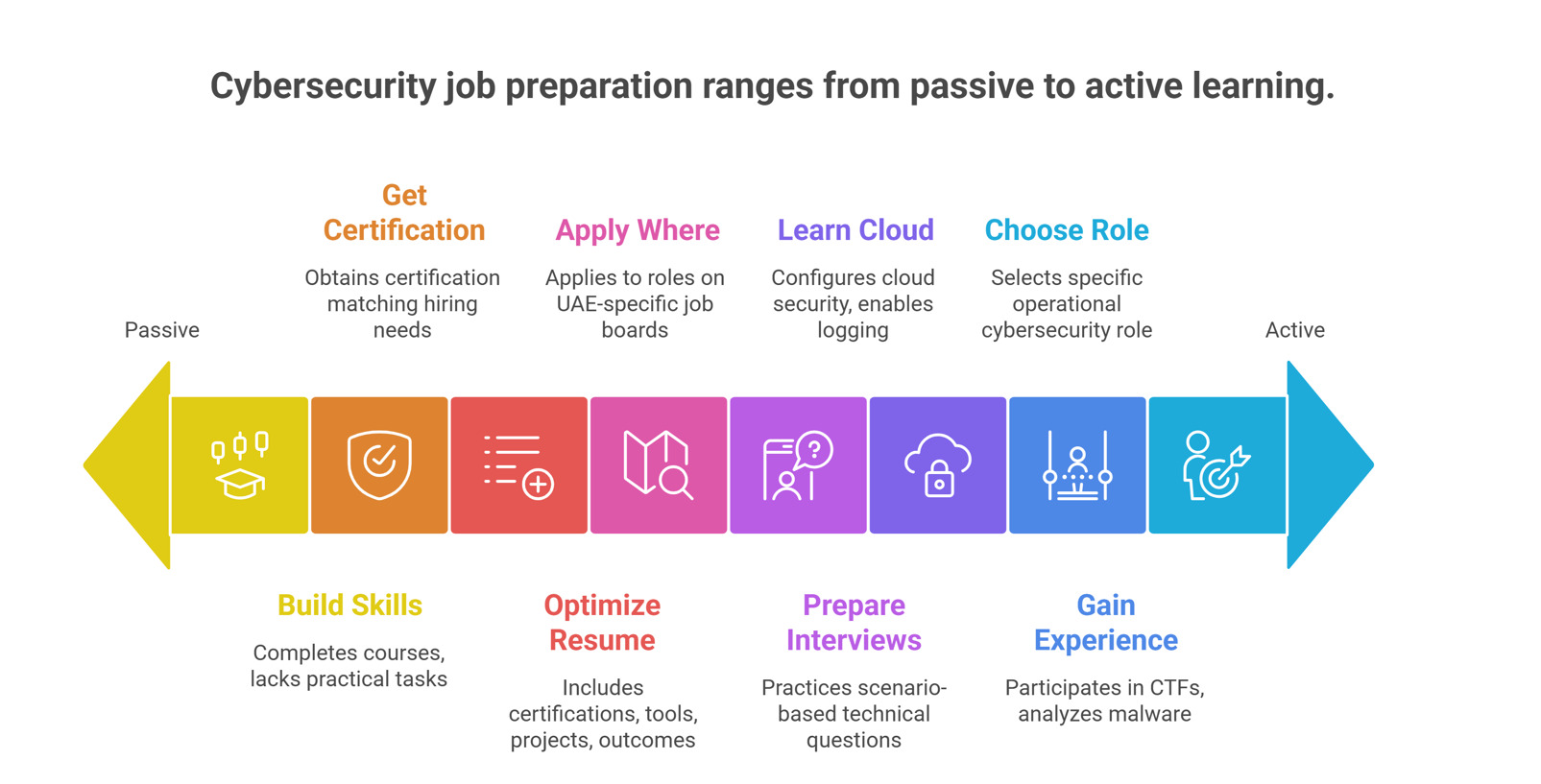
Many job seekers apply for cybersecurity roles in Dubai and Abu Dhabi without understanding how hiring actually works in the UAE market. Most rejections happen because they don't follow generic preparation paths that do not match employer expectations.
Step 1: Choose a Cybersecurity Role Before Learning Anything
A common mistake involves trying to learn everything at once. UAE recruiters hire for specific operational roles associated with cybersecurity. Start by selecting one clear path from SOC Analyst, Cybersecurity Analyst, Security Engineer, Cloud Security Specialist, and Penetration Tester, or you can choose any of the cybersecurity roles.
Action you can take today:
- Open LinkedIn
- Search Cybersecurity jobs in Dubai
- Open 20 job listings
- Write down repeated skills appearing in descriptions
Your learning plan must match those repeated requirements
Step 2: Build Skills Based on UAE Job Descriptions, and do not focus on courses
Many candidates complete courses but still fail interviews because they cannot perform practical tasks. Employers expect you to answer questions such as:
- How would you investigate a phishing alert?
- What steps follow a detected intrusion?
- How do you secure cloud access?
Do this instead of passive learning:
Create a home cybersecurity lab and practice:
- Monitoring logs using free SIEM tools
- Detecting suspicious login attempts
- Running vulnerability scans
- Investigating simulated attacks
Practical setup
- Install VirtualBox
- Add Linux and Windows machines
- Generate attack traffic using practice tools
Interviewers value demonstrated experience more than certificates.
Step 3: Get One Certification That Matches Hiring Needs
Certification choice directly affects interview chances in the UAE hiring. Use this decision rule:
|
Target Role |
Certification to Start |
|
SOC Analyst |
CompTIA Security+ |
|
Threat Monitoring |
Cisco CyberOps |
|
Ethical Hacker |
CEH |
|
Cloud Security |
AWS Security |
|
Senior Roles |
CISSP |
Action Plan:
- Set a 90-day deadline
- Study 2 hours daily
- Schedule the exam before finishing the preparation
Step 4: Gain Experience Without Waiting for a Job
UAE employers frequently ask: Show us what security work you have done.
You can build experience without employment with the following steps:
- Participate in Capture-the-Flag platforms
- Analyze the safety of public malware samples safety
- Write incident investigation reports
- Document vulnerability findings
Post your work weekly on LinkedIn. Recruiters searching for candidates often contact active learners directly.
Step 5: Learn Cloud Security Early
Dubai and Abu Dhabi companies rapidly move infrastructure to cloud platforms. Candidates without cloud exposure face limited opportunities. Focus on practical cloud tasks:
- Create an AWS Free Tier account
- Configure Identity and Access Management
- Enable logging and alerts
- Secure storage permissions
Many UAE job listings mention AWS or Azure, even for junior roles. One completed cloud security project greatly improves shortlist chances.
Step 6: Optimize Your Resume for UAE Recruiters
Sending international-style resumes reduces response rates. UAE cybersecurity resumes should include:
- Certifications at the top
- Security tools used
- Hands-on projects
- Incident response examples
- Cloud exposure
Avoid long academic descriptions and replace responsibilities with measurable outcomes.
Step 7: Apply Where UAE Recruiters Actually Hire
Many candidates apply only through global job boards. UAE recruiters actively source talent from:
- Bayt
- GulfTalent
Application strategy that works:
- Apply to 5-10 roles daily
- Message recruiters politely after applying
- Connect with cybersecurity managers in UAE companies
Step 8: Prepare for UAE Cybersecurity Interviews
Technical interviews focus on scenarios. Practice answering:
- How would you respond to ransomware detection?
- Steps after suspicious login alerts?
- Methods to secure cloud access?
Interviewers assess the thinking process rather than memorized answers.

Frequently Asked Questions
Blogs and Articles
- Oct 12, 2026
- Technology
How to Learn AI for Business in 2026: A Guide for Managers and Working Professionals
- Learn how to use AI for business in 2026 with practical AI tools, automation strategies, and essential skills to improve decision-making, productivity, and business performance.


- Sep 29, 2026
- Management

- Sep 28, 2026
- Management

- Sep 12, 2026
- Technology