

 UAE
UAE

 United Kingdom
 Switzerland
 United States

















 Italy
Italy France
 India
India UAE
UAE Germany
 Russia
 Malaysia
 Spain
Spain United States
 Malta
Malta
Step-by-Step Guide to Study Abroad in France for International Students
Step-by-Step Guide to Study Abroad in France for International Students
In November 2018, the French Government officially launched its highly ambitious initiative, Bienvenue en France (managed by Campus France), to attract 5,00,000 students by 2027. It was also meant to give them housing and administrative support, along with solidifying the country's position as a global destination for top-of-the-line education programs.
The initiative drew over 4,43,000 international students who opted for French education enrollment for the year 2024-2025, demonstrating how the country is getting closer to meeting its target. And to speed it up, the government initiated a host of supplementary programs, including streamlined visa processes, English-taught programs and a quality label for universities.
Cost remains a major reason students choose France. Public universities in France charge much lower fees than those in many Western destinations (see the image guide below).
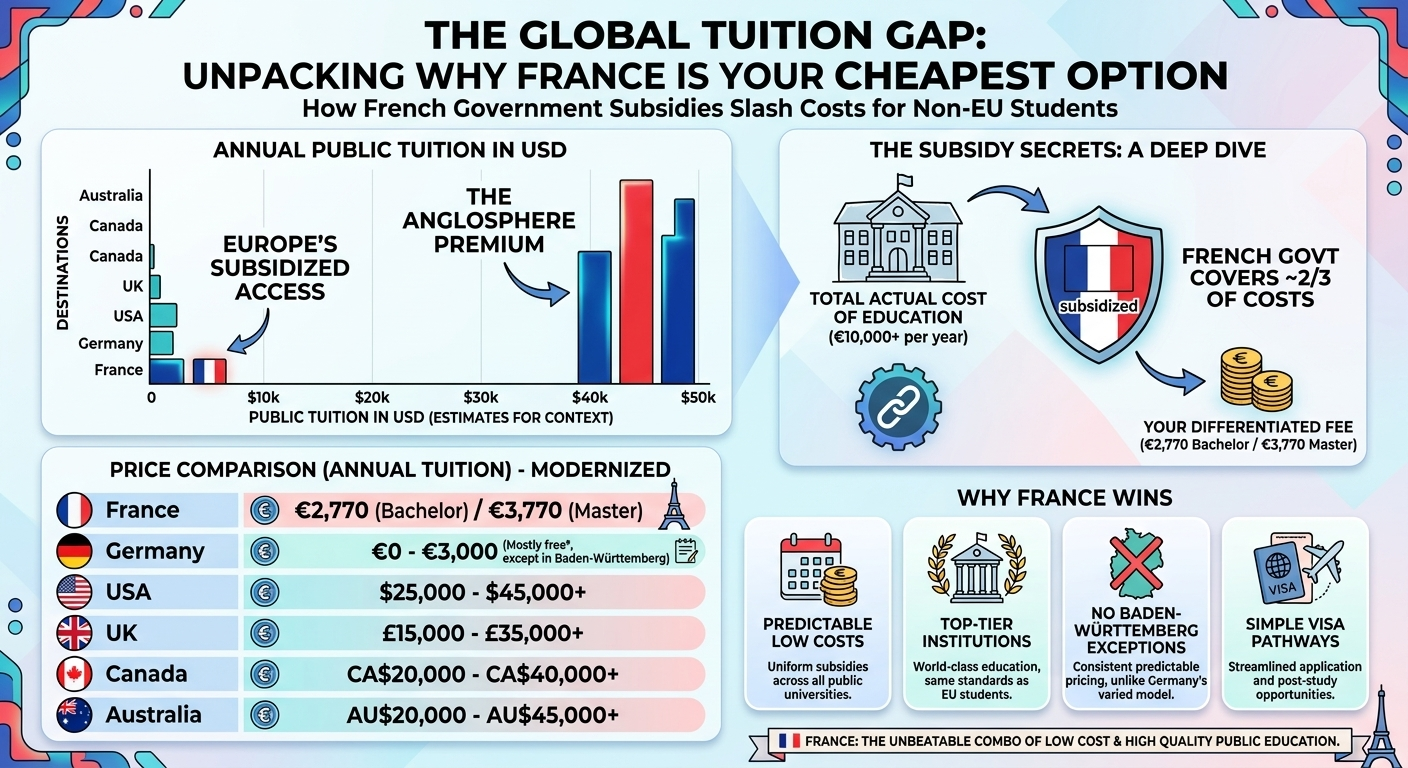
For non-EU students, annual tuition at public institutions is often around €2,770 for a bachelor's and about €3,770 for a master's programme, which is far less than comparable degrees in the UK or the United States.
How the French Government is subsidising the cost of education for international students, and why does it matter?
Studying in France is not only an opportunity to gain access to some of the world's most fantastic and reputable academic institutions, facilitating higher programs, but it also means availing subsidised costs on higher education.
However, the actual cost is not different from that of other countries; the real difference is that the French government unloads a large share of the costs from your shoulders. It pays most of the cost of your degree program in a public institution of higher education.
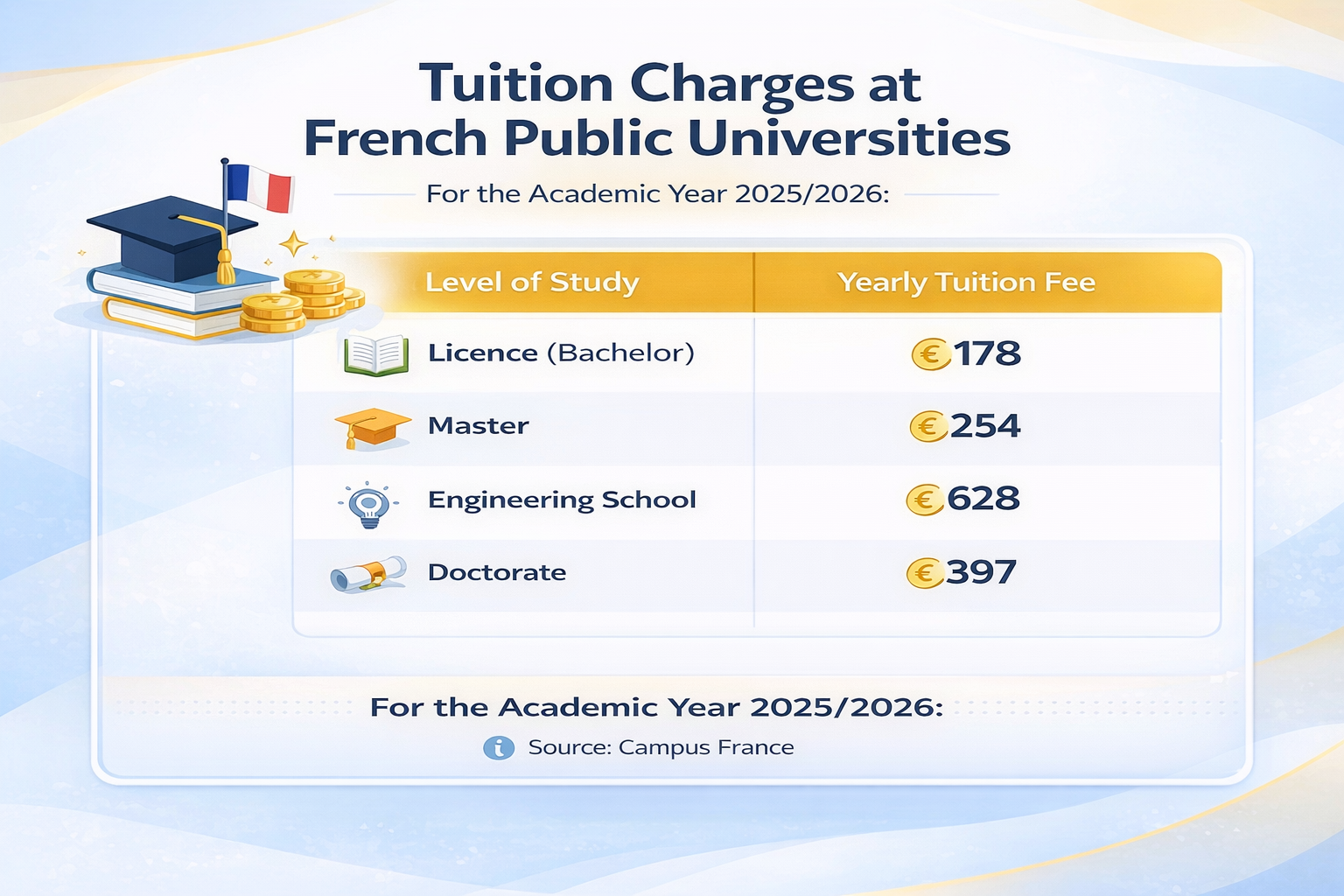
Also, international students enrolling for a degree at the Doctorate level at the start of their academic year 2025 will be eligible for (most of) the subsidised cost of their education by the State until the degree programme is completed.
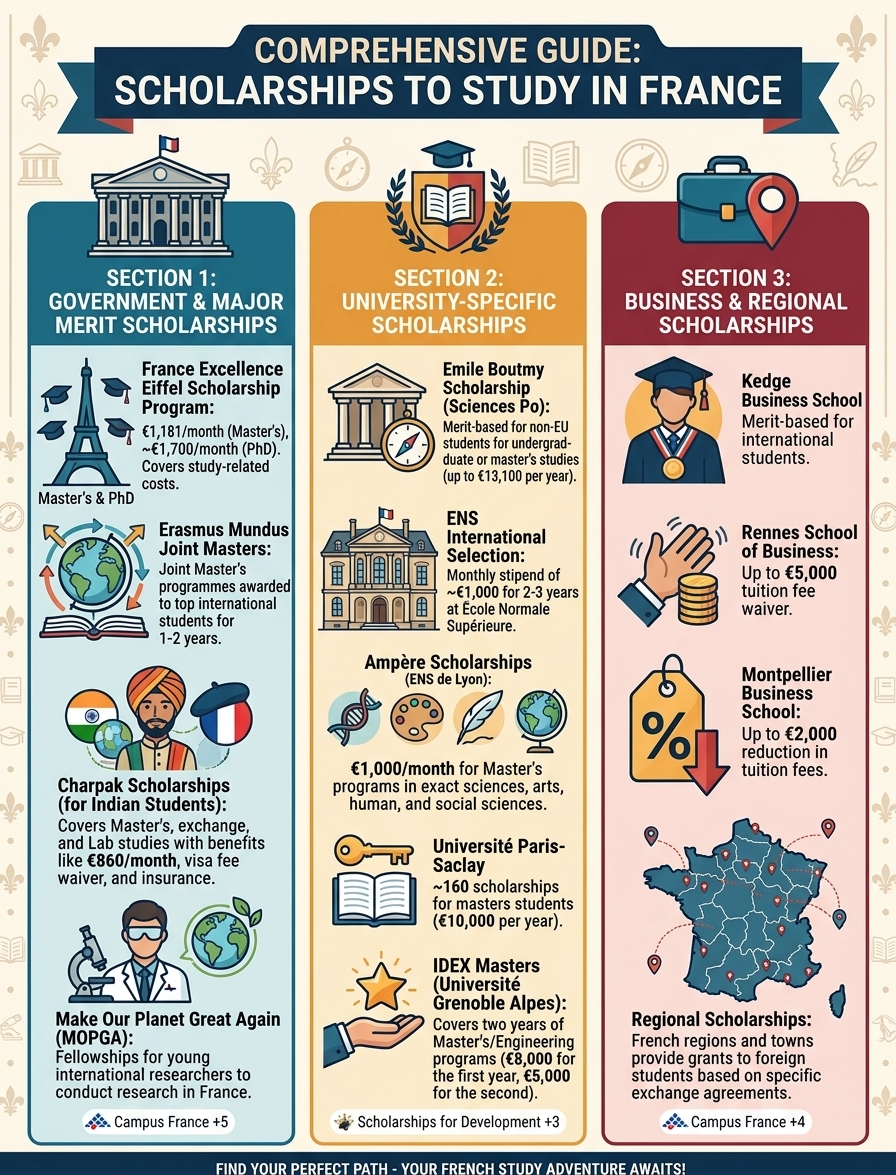
To encourage more international students to choose French universities for higher programs, the country offers a host of top scholarships (see image guide), including:
- France Excellence Eiffel Scholarship Program
- Erasmus mundus joints masters
- Charpak Scholarships (for students from India)
- Make our planet great again (MOPGA)
- The Université Paris-Saclay international master's scholarships
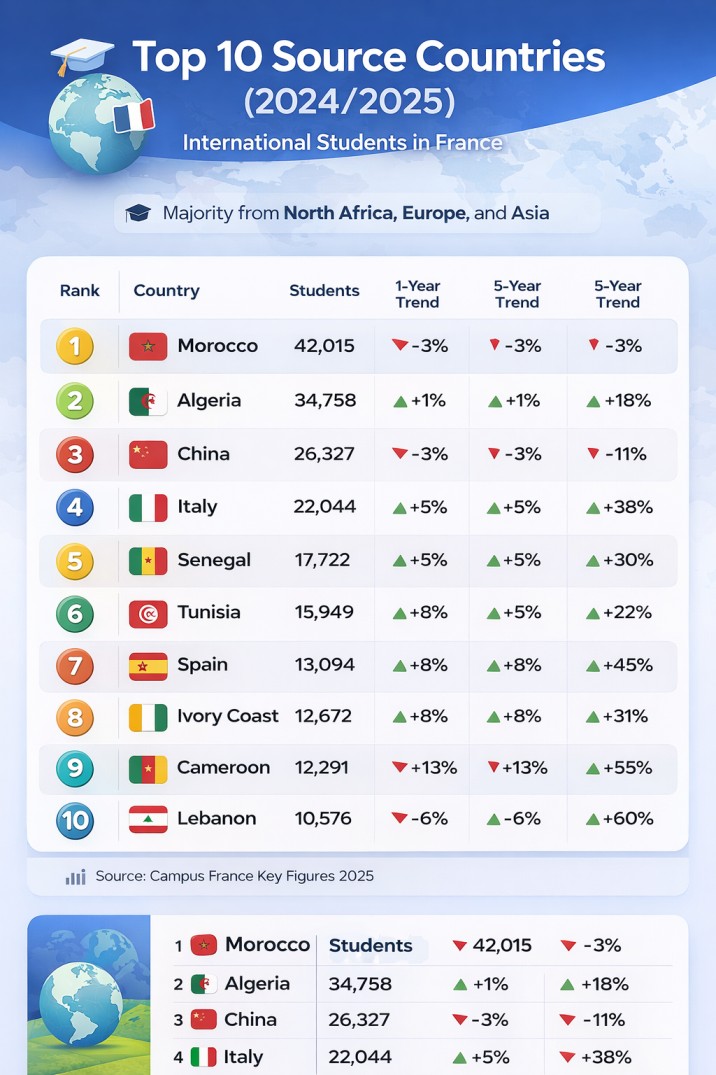
Top source countries for French education enrollment
The way the French government's initiative has worked out, with over 430000 students having already made a beeline for academic enrollment, it showcases the country's relentless effort to certify its position as one of the world's top education hubs for international students.
Here's the list of top source countries whose students enrol for French education, accentuating the country's growing global clout as one of the sought-after destinations for international students to study abroad in France.
- Morocco - It is the largest source country with more than 42,000 students
- Algeria - the second top source country with over 34,000 students
- China - The third largest source with over 26,000 students
- Italy - The fourth top source with over 22,000 students
- Senegal - The fifth largest source, with more than 17,000 students
India is growing fast as one of the top source countries with 9,100 students for French education enrollment.
Despite strong interest, many students feel confused by the process of studying in France. This guide solves that problem too. It explains each stage in the correct order so students know what to do, when to do it, and how to avoid common mistakes.
Below is a quick checklist for the readers who want a clear plan from first research to arrival in France.
-
Choose a course
-
Prepare for exams
-
Take tests
-
Collect documents
-
Apply
-
Get offer
-
Arrange funds
-
Apply for a visa
-
Find housing
-
Fly to France
Step 1: Choose Course and University
Match subjects with career goals.
-
Want a tech career? Look for computer science or engineering degrees.
-
Want business roles? Choose management, finance, or marketing programmes.
-
Want research roles? Pick strong academic universities with a research focus.
Note: Students should use only trusted sources like official university websites for course pages and admission rules.
What to check before applying
Always review:
-
Entry criteria such as grades, test scores, and background subjects.
-
Tuition fees for the full programme duration
-
Location, such as city size, cost of living, and transport access
-
Language of instruction: English or French
Read Also: How to Study Abroad in 2025 – Step-by-Step Guide for Global Students
Step 2: Entrance Exams and Basic Preparation Guide
Universities in France set exam rules based on the programme and language of teaching.
Exam for English-taught programmes
Most universities ask for one of these:
-
IELTS
-
TOEFL
-
Duolingo English Test
Common score ranges include IELTS: 6.0 to 6.5, and for TOEFL, it's 80 to 95. For these exams, you need to learn the four parts: listening, reading, writing, and speaking; take one practice test early to see your level; study a little every day instead of cramming; use official materials such as Cambridge IELTS books, British Council practice tests, and ETS TOEFL samples; and record speaking answers and review them weekly.
Exams for business schools
MBA and management programmes may ask for:
GMAT or GRE: Focus on math basics and vocabulary first, practice questions daily, take one full mock test each week, and start preparation at least 3-6 months before the test date.
Exams for French-taught programmes
DELF (usually B1 or B2 level) or DALF (C1 for advanced study): Study French grammar daily, listen to French news and videos, practise speaking with partners, and use official DELF practice books.
Step 3: Prepare your Documents
This step decides whether universities take your application seriously. Missing or weak documents lead to rejection, even with good grades.
Academic transcripts
These show your subjects and marks from school or college.
-
Use official transcripts from your institution.
-
Check that your names and grades match your passport.
-
If documents are not in English or French, arrange certified translations.
Statement of Purpose
This is your personal essay. It explains:
-
Why did you choose this course?
-
Why did you choose this university?
-
What your career plan looks like
Keep it honest and specific. Avoid copying samples from the internet. Universities detect copied content easily.
Tip: Start writing at least three to four weeks before deadlines so you have time to edit.
Letters of Recommendation
These come from teachers, professors, or supervisors who know your work.
-
Ask people who taught you recently.
-
Share your resume and goals with them.
-
Request letters at least one month before the deadline
Last-minute requests often lead to rushed and weak letters.
Resume
Your resume should stay simple and clear. Include
-
Education
-
Projects
-
Internships
-
Skills
-
Certifications
Passport
Your passport must stay valid for the entire study period.
-
Check the expiry date early.
-
Renew it before applying if it expires soon.
Many visa applications fail because of passport validity issues.
Exam scores
Upload official score reports for:
-
IELTS, TOEFL, Duolingo
-
GMAT, GRE
-
DELF or DALF if required
Always send the exact version requested by the university.
Common mistakes to avoid
-
Uploading blurry documents
-
Using different names across documents
-
Missing deadlines
-
Submitting without proofreading
Step 4: Complete the Application Process
Students can apply in 2 main ways. The route depends on nationality and university rules.
Option 1: Apply through Campus France
Many countries must use Campus France. The steps stay simple:
-
Create an account on the Campus France portal
-
Fill in personal details and education history
-
Upload required documents
-
Pay the application fee
-
Book and attend the Campus France interview if required
After approval, Campus France sends your file to the chosen universities.
Option 2: Apply directly to universities
-
Some universities allow direct applications.
-
Create an account on the university application portal
-
Complete the form and upload documents
-
Submit before the deadline
-
Check email regularly for updates or extra requests.
Deadlines students must know: most programmes close applications between December and April. Some competitive programmes close earlier. Always check deadlines on each university website.
Missing a deadline usually means waiting for the next intake.
Step 5: Offer Letter and Acceptance Process
If a university selects you, it sends an offer letter.
Conditional offer
This means the university still needs something:
Common conditions include:
-
Final exam results
-
Updated transcripts
-
English or language test score
You must submit missing items before the deadline.
Final offer
This means you meet all conditions. You can move to visa preparation.
Accepting the offer
-
Accept the offer on the university portal
-
Some universities ask for a deposit to confirm your seat.
-
Keep a copy of the offer letter for visa use.
-
Never accept multiple offers unless the rules allow it.
Step 6: Budget Planning
Students must plan costs early to avoid visa and settlement problems.
Main expenses
-
Tuition: Public universities often cost a few thousand euros per year. Private schools cost more.
-
Rent: Smaller cities cost less than Paris.
-
Food: Grocery shopping keeps costs lower.
-
Transport: Students get discounted travel passes.
-
Health insurance: Mandatory for all students
Proof of funds for a visa
Visa officers want proof that you can support yourself. This usually includes:
-
Bank students
-
Scholarship letters
-
Sponsor documents if parents support you.
Insufficient financial proof can lead to visa refusal, even with an admission offer.
Step 7: Complete the Student Visa Process
This step worries many students, but the process follows a fixed order. If documents stay complete and honest, approval becomes much easier.
1. Get an admission letter: You must hold a confirmed offer from a French institution before starting the visa process.
2. Finish Campus France approval: If your country uses Campus France, your file must show "validated" status. Without this, VFS will not accept your visa file.
3. Book a visa appointment: Book your slot through the official France visa or VFS portal. Slots fill fast, so book early.
4. Submit documents at the centre: Carry originals and copies. Staff, check your file and collect biometrics.
5. Attend a short interview: Some students answer basic questions about the course, the university, and study plans. Know your choices well.
Documents you will need:
Prepare these in advance:
-
Valid passport
-
Admission letter from the university
-
Campus France approval (if applicable)
-
Visa application form
-
Passport-size photos
-
Proof of funds (bank statements, sponsor letter, or scholarship proof)
-
Tuition payment proof is provided if paid
-
Accommodation proof in France
-
Travel insurance
-
Academic transcripts and certificates
-
Language test scores
-
Appointment confirmation receipt
Common reasons students face rejection
-
Weak financial proof
-
Missing documents
-
Mismatch between the course and the background
-
Inability to explain the study plan during the interview
Work and Post-Study Pathways: International students can work up to 20 hours per week while enrolled. After graduation, France offers a temporary residence permit (APS) that allows graduates to look for jobs or start businesses before switching to a longer-term work visa.
Step 8: Housing Search
Finding a place early reduces stress and avoids last-minute high prices.
Main options for students
-
CROUS student residences: Government-run housing with lower rent. Rooms fill fast, so apply as soon as you accept your offer.
-
University housing: Some universities offer on-campus rooms or partner residences. Ask your admissions office.
-
Private rentals: Studios or apartments rented through agencies or online platforms. Landlords may ask for a guarantor.
-
Shared apartments: You split rent and bills with other students. This option cuts costs and works well in big cities.
When to start searching: Start right after you accept your offer letter. Most students begin 2-3 months before arrival. Waiting too long limits choices.
Step 9: Travel and Packing
This step should stay simple and planned.
Book your flight only after visa approval.
-
Carry all important papers in your hand luggage.
-
Passport
-
Visa
-
Offer letter
-
Accommodation proof
-
Insurance
Pack for the first month: basic clothes for the season, personal medicines with prescriptions, a universal plug adapter, and copies of all documents.
Note: Do not overload luggage. You can buy most items after arrival.
Step 10: Gather Essentials for First Week in France
These tasks help you settle quickly.
-
Register at the university: Complete enrolment and confirm attendance.
-
Collect a student card: This card provides access to libraries, exams, and student discounts.
-
Open a bank account: You need it for rent, salary, and housing support.
-
Buy a local SIM card: This helps with calls, maps, and university updates.
-
Register for health insurance: This is mandatory for medical care and reimbursements.
Finish these steps in the first week so daily life runs smoothly.
Renewal of Residence Permit
Many programmes last longer than one year. Students must renew their legal stay to continue their studies in France.
Who needs renewal?
-
Students enrolled in programmes longer than 12 months
-
Bachelor's, master's, and PhD students staying beyond the first visa period.
What students must show
During renewal, authorities check three things:
-
Proof of enrolment for the next academic year: Universities provide enrolment certificates.
-
Proof of funds to support living costs: Banks provide statements.
-
Valid housing address in France: Landlords or residents provide address proof.
Most renewals happen online through the official French administration portal. Some regions still require in-person appointments in the prefecture.
-
Apply before the residence permit expires.
-
Start the process 2-3 months early
-
Late applications can lead to legal issues or rejection.
Read Also: Take the First Step to Study Abroad: Leverage EuroAmerican Group
How is France unique in offering the CAF housing allowance, refunding students' nearly 40% rent monthly?
Caisse d'Allocations Familiales (CAF) housing allowance is a monthly, state-funded aid that provides an income-based, and almost universal subsidy for rent. It helps domestic and international students cut short on the rent cost by nearly 40%. Therefore, it is a significant relief from the burden of living costs for the students. What makes it unique is its universal eligibility, which means the allowance can be availed by students regardless of their nationality. It serves as a huge financial relief on rent for the students. When it comes to availing the allowance directly, students are to follow the online processes, which have been streamlined by the government.
Conclusion
Success in this process does not depend on luck. It depends on early planning, strong documents, exam preparation, and following deadlines. Students who start 10-12 months before intake face fewer rejections, fewer visa issues, and better housing choices.
Every step in this guide builds control. When students follow each step in order, studying in France becomes practical and achievable rather than confusing.

Frequently Asked Questions
Blogs and Articles
- Oct 23, 2026
- Management
A Thorough Evaluation of EIMT Switzerland: Assessing the Global Utility of Its Online DBA
- EIMT Switzerland’s online DBA is a three-year doctoral program designed for working professionals, combining advanced management studies, applied research, and a practical dissertation. This review examines its academic credibility, international recognition, admission requirements, tuition fees, career relevance, and key factors to verify before enrolling.


- Oct 22, 2026
- Technology

- Oct 12, 2026
- Technology

- Sep 29, 2026
- Management