

 UAE
UAE

 United Kingdom
 Switzerland
 United States

















 Italy
Italy France
 India
India UAE
UAE Germany
 Russia
 Malaysia
 Spain
Spain United States
 Malta
Malta
Generative AI vs. Predictive AI: What are the Differences and When to Use?
Generative AI vs. Predictive AI: What are the Differences and When to Use?
The global enterprise technology market has reached a critical turning point. Companies are no longer asking what artificial intelligence can do. Instead, they are figuring out which type of AI handles which specific business problem.
The biggest confusion in boardrooms and research labs today lies in the difference between Generative AI and Predictive AI. Both these technologies are by no means same or interchangeable. The two use entirely different mathematical foundations and serve entirely different business purposes.
The core difference comes down to creation versus forecasting. While Generative AI studies patterns of data to come up with something entirely new and unique such as text, code, and images, Predictive AI relies on the analysis of past data to see into the future, and calculate the estimated probability of an event happening.
The AI Paradigm
|
Aspect |
Generative AI |
Predictive AI |
|
Core Question |
"What could a solution look like?" |
"What will the exact outcome be?" |
|
Primary Output |
Brand-new data, content, or arrays. |
High-accuracy numerical predictions and probabilities. |
|
Primary Action |
Creates, generates, and synthesizes new content or data. |
Forecasts, predicts, and classifies future outcomes. |
The financial stakes behind this tech divide are huge. According to recent institutional market data, the global Grand View Research Generative AI Market Report states that the market size reached a valuation of USD 22.2 billion in 2025. This is projected to expand significantly to USD 29.6 billion in 2026.
Concurrently, the global predictive computing framework is growing rapidly. Comprehensive data published in the Market.us Predictive AI Report tracks the global predictive intelligence sector climbing to an estimated USD 22.1 billion by the end of 2025, heading towards a projected valuation of USD 108 billion over the next decade.
For working professionals, advanced research students, and CXOs, mixing up these two tools is a costly mistake. Deploying a generative model to solve a predictive problem leads to expensive, inaccurate results. Conversely, using a predictive model for a creative task delivers rigid, useless outputs. Understanding the boundary between these two systems is the foundation of modern technology strategy.
What Generative and Predictive AI Have in Common Behind the Scenes
Despite their divergent output goals, Generative AI and Predictive AI are deeply interconnected siblings that run on the same basic machine learning principles. Before diving into their architectural differences, it is critical to recognize what they share in common:
- Dependency on High-Quality and Reliable Data: Both systems are completely powerless without vast quantities of training data. If you feed them corrupted, biased, or incomplete datasets, both models will degrade fast. They operate strictly under the computer science law of "Garbage In, Garbage Out."
- Neural Network Foundation: Neural Network Architecture: In terms of architecture, both systems incorporate artificial neural networks. Neural networks replicate the functionality of the human brain whereby data arrays are passed through layers of mathematically connected nodes (neurons), while the weights of connections are altered iteratively to learn underlying patterns.
- Machine Learning Core: Both fields are sub-disciplines of Machine Learning (ML) and broader field of Artificial Intelligence. Neither of the systems relies on rigid, static "if/then" programming. Instead, they must be fed information, go through a formal training phase, and dynamically optimize their internal parameters over time.
- Goal of Automation: Ultimately, both technologies are built to minimize manual human intervention. Whether an engine is calculating a future stock trend or drafting a legal contract, the primary business objective is to scale operations, reduce processing timelines, and maximize corporate efficiency.
Read Also: What Is Janitor AI? Features, Uses and How It Works
Deep Structural Comparison: Architectural and Mathematical Foundations
In order to understand these technologies, we must look beneath the surface. They function on entirely different computational frameworks and process underlying data structures in contrasting ways.
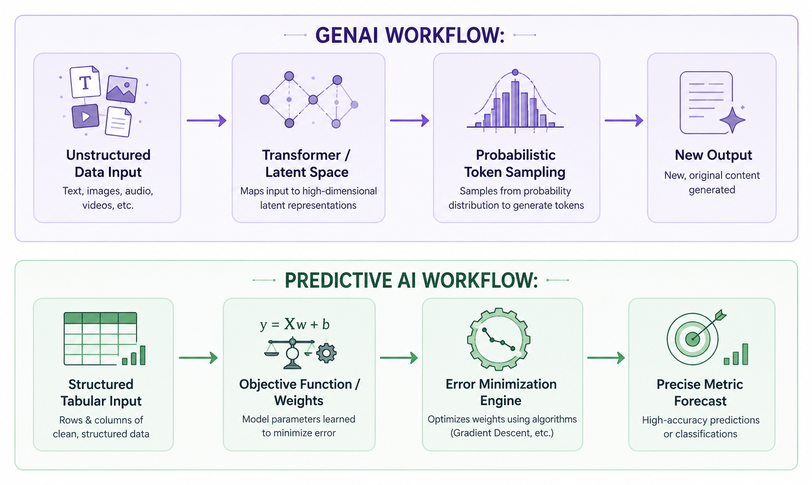
- Generative AI
Generative AI runs primarily on deep neural network architectures known as Transformers, along with Diffusion Models for image creation. The core component of the modern generative systems is the Large Language Model (LLM). The training takes place on large amounts of unstructured multi-modal data such as books, websites, images, and videos. During this training, the model understands the relationship between tokens/words/pixels.
Mathematically, Generative AI maps these relationships inside a very large multidimensional map called a latent space. When you give a prompt to a generative model, it does not look up a pre-written answer. Instead, it scans through this latent space. It calculates the statistical probability of what the next piece of data should be.
Every word an LLM outputs is simply a statistically informed prediction of the next most logical word. It samples from a complex probability distribution to invent a brand-new data array that has never existed before.
- Predictive AI
Predictive AI is dependent on classic machine learning techniques and complex statistical frameworks. Linear regression, logistic regression, Random Forests, and gradient boosting models, including XGBoost, along with neural networks form its main set of tools. As opposed to generative AI, predictive AI does not generate new data. Instead, it takes highly structured data in a tabular format, like sales history tables, user sign-in information, or sensor data readings.
Objective Function: In a predictive model, from a mathematical standpoint, the objective function should be minimized. The model studies various historical data sets and finds trends, patterns, and correlations between them. It assigns different mathematical weights to different variables.
Once a new set of data is fed into the model, it makes projections on that new data by using the historical patterns it found. It computes a number or a risk score or even classifies it into categories based on the historical data available. It tells you exactly what will happen based on what has already happened.
Conceptual Mapping
Differences At A Glance
|
Feature / Pointer |
Generative AI (Gen AI) |
Predictive AI |
|
Primary Goal |
Creates novel content and data. |
Forecasts future trends and behaviors. |
|
Output Type |
Text, images, code, audio, 3D models. |
Numbers, probabilities, classifications, scores. |
|
Core Mechanism |
Learns patterns to generate new examples. |
Learns patterns to evaluate unseen data. |
|
Common Algorithms |
LLMs, GANs, Diffusion Models, Transformers. |
Linear Regression, Random Forests, XGBoost. |
|
Data Requirements |
Massive, unstructured datasets. |
Structured, historical tabular data. |
|
User Interaction |
Prompt-driven, conversational interfaces. |
Query-driven, automated dashboards, APIs. |
|
Primary Business Risk |
Hallucinations and intellectual property issues. |
Overfitting and algorithmic bias. |
|
Typical Use Cases |
Copywriting, chatbots, design prototyping. |
Fraud detection, churn prediction, stock forecasting. |
You can think of the difference between Generative AI and Predictive AI in this way:
- Generative AI works through probabilistic synthesis. It explores a vast, creative space to deliver a unique, adaptive response.
- Predictive AI works through mathematical extrapolation. It narrows down variables to a single, highly accurate data point with a specific confidence score.
High-Fidelity Enterprise Use Cases (The Real-World Divide)
Let us move from theory to practice. Seeing how both systems operate inside the same industry sector highlights their distinct structural strengths.
Banking & Financial Services (BFSI)
The financial world relies heavily on both technologies, but keeps them strictly separated across different departments.
- Predictive Role: A credit card company uses a predictive model to spot fraud. The system monitors thousands of regular credit card transactions every second. If a transaction suddenly occurs at an odd time or an unexpected location, the predictive algorithm flags it instantly. It calculates an exact fraud risk percentage. If that percentage crosses a set limit, it locks the card automatically.
- Generative Role: A wealth management division uses Generative AI to improve customer communication. The agent scans a client’s portfolio data and automatically drafts a personalized financial summary letter. It translates complex market movements into plain English or regional Indian languages. It creates a smooth, easy-to-read narrative, saving human financial advisors hours of manual typing.
Supply Chain & Logistics
Modern logistics hubs use both systems to keep global and domestic trade routes running smoothly without interruptions.
- Predictive Role: An e-commerce platform uses predictive analytics to optimize warehouse inventory before major festival sales. The model reviews sales data from the past five years, factoring in weather trends and local economic shifts. It tells the operations team exactly how many units of an item they need to stock in a specific warehouse to avoid stockouts.
- Generative Role: When a logistics delay happens, a generative model steps in to manage the supply chain fallout. It reviews the shipping issue, references the supplier contract, and automatically writes a localized vendor dispute email. It handles the initial multi-lingual correspondence with international shipping partners, keeping communications fast and professional.
Healthcare & Life Sciences
In medicine, the division of labor between these two AI engines can directly impact patient wellness and drug discovery speeds.
- Predictive Role: Oncologists use predictive AI to analyze medical imaging scans [market.us]. The algorithm reviews thousands of historic MRI pixels to identify incredibly tiny anomalies that the human eye might miss. It calculates the exact probability of a tissue spot being a health risk, alerting doctors to intervene early.
- Generative Role: Pharmaceutical researchers use generative models to accelerate drug discovery workflows. Instead of spending years testing random chemical combinations manually, scientists use generative systems to design entirely new synthetic molecular structures. The model creates brand-new chemical blueprints tailored to block specific disease proteins, dropping early-stage drug design timelines from years to days.
Symbiotic Enterprise Stack: Convergence & Multi-Agent Systems
Strategic advantage happens when an organization stops viewing these technologies as rivals and starts combining them into a unified system. High-performance enterprise architectures run both engines inside a single, continuous workflow loop.
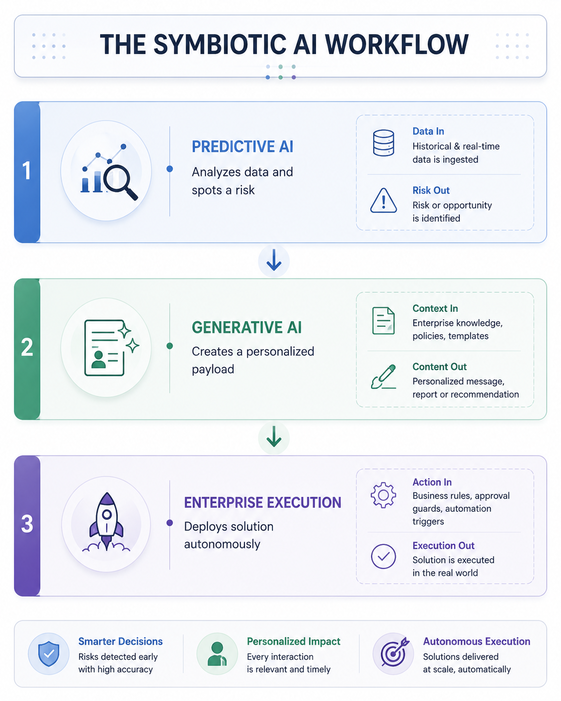
Consider a modern customer retention system for a major telecom or SaaS company. First, the predictive AI engine continuously monitors user activity data, checking login frequencies, service dropouts, and billing patterns. The model notices a subtle drop in a customer's usage pattern. It flags this user as a high churn risk, estimating an 85% chance that the client will cancel their subscription next month.
The system does not just log this score on a dashboard. It automatically passes the alert to a Generative AI agent.
The generative model reviews the user's history and creates a highly personalized retention offer. It writes a custom email offering a discount on the exact features the user values most. The generative system handles the messaging, while the predictive system provides the underlying data justification. This creates a fully automated corporate workflow that saves customers before they walk out of the door.
Risk Matrices, Governance, & Resource Costs
Deploying these advanced systems requires a clear understanding of their unique security risks, data needs, and operational costs.
|
Metric |
Generative AI Stack |
Predictive AI Stack |
|
Primary System Risk |
Hallucinations: Inventing facts that sound plausible but are totally false |
Data Drift: Model accuracy drops when real-world patterns change from historic baselines. |
|
Computer Profile |
High real-time inference costs. Requires heavy GPU networks for token processing. |
Low real-time inference costs. Requires high compute mainly during initial training phases. |
|
Data Prerequisites |
Massive, unstructured multimodal datasets (text, code, image libraries). |
Clean, structured, historical tabular data (databases, logs, rows). |
|
Governance Need |
Strict output filtering to prevent bias, toxic language, and data leaks |
Frequent model retraining and performance monitoring to prevent systemic bias. |
Handling the Risks
- GenAI Governance: To stop a generative model from hallucinating false information, IT teams must use a framework called Retrieval-Augmented Generation (RAG). RAG anchors the creative model to a verified corporate database, ensuring it only builds text using accurate, approved facts.
- Predictive AI Governance: To keep a predictive model from failing, data engineers track model degradation. If consumer buying habits change due to a sudden market shift, the historic training data becomes obsolete. Engineers must continuously feed fresh data streams into the system to keep its forecasts accurate.
Conclusion and CXO Action Plan
The enterprise landscape has moved past the phase of superficial AI experimentation. Winners are separating themselves by building mature, dual-engine architectures that maximize the strengths of both tools.
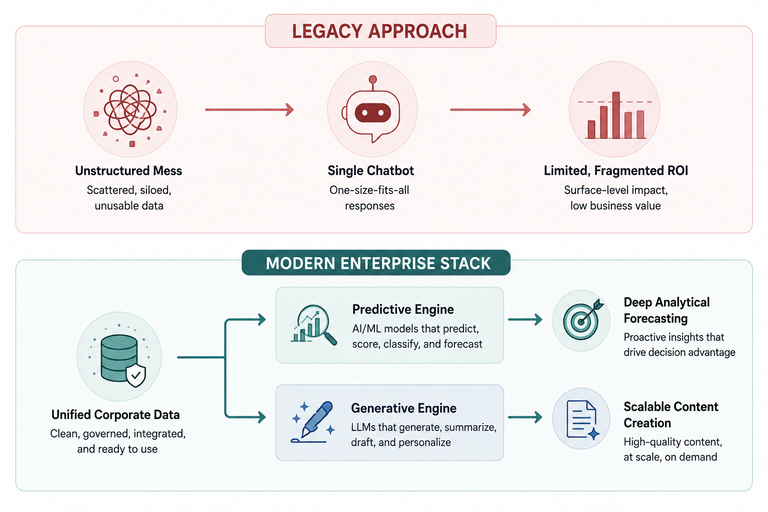
If your company only deploys generative chat tools, you are leaving a massive amount of value on the table. You will end up with an organization that is great at talking, but completely blind to upcoming market shifts, financial risks, and customer churn trends.
True operational superiority belongs to companies that connect both engines. Use Predictive AI to calculate the numbers and spot the patterns, then deploy Generative AI to automate the creative execution. By building this complete cognitive loop, you transform your corporate data into a highly efficient for long-term business growth.

Frequently Asked Questions
Blogs and Articles
- Sep 14, 2026
- Management
Online DBA: EIMT vs SIMA vs Dunster vs Geneva Business School
- Compare EIMT, SIMA, Dunster, and Geneva Business School to understand key differences in online DBA programs, including study format, flexibility, duration, fees, accreditation, and career value.

- Sep 12, 2026
- Technology

- Sep 11, 2026
- Technology
- Aug 28, 2026
- Technology