

 UAE
UAE

 United Kingdom
 Switzerland
 United States

















 Italy
Italy France
 India
India UAE
UAE Germany
 Russia
 Malaysia
 Spain
Spain United States
 Malta
Malta
Generative AI Vs. Agentic AI - Key Differences, Characteristics, and Use Cases Explained
Generative AI Vs. Agentic AI - Key Differences, Characteristics, and Use Cases Explained
If you are familiar with the world's most popular large language model, ChatGPT, then you already know about generative AI. In a world dominated by super-intelligent machines penetrating almost every aspect of human life, the presence of generative AI models is ubiquitous.
What is Generative AI?
Generative AI is a narrow artificial intelligence designed to create texts, images, videos, and music content based on a user's prompts. All the popular generative AI models like ChatGPT, Gemini, Perplexity AI and Claude are content-generating chatbots. Meaning, as a user, all you have to do is instruct a specific generative AI model with your creatively worded instructions called prompts, and it will generate content accordingly.
Depending on a model's architectural advancement, it can also provide you with a tailored experience for the content you prompt it.
The use of generative AI has become so pervasive worldwide today that it is almost impossible to believe someone is not familiar with an AI chatbot.
Back in the days when ChatGPT was launched in 2022, it broke all the records in the history of app downloads, having surpassed 900 million downloads.
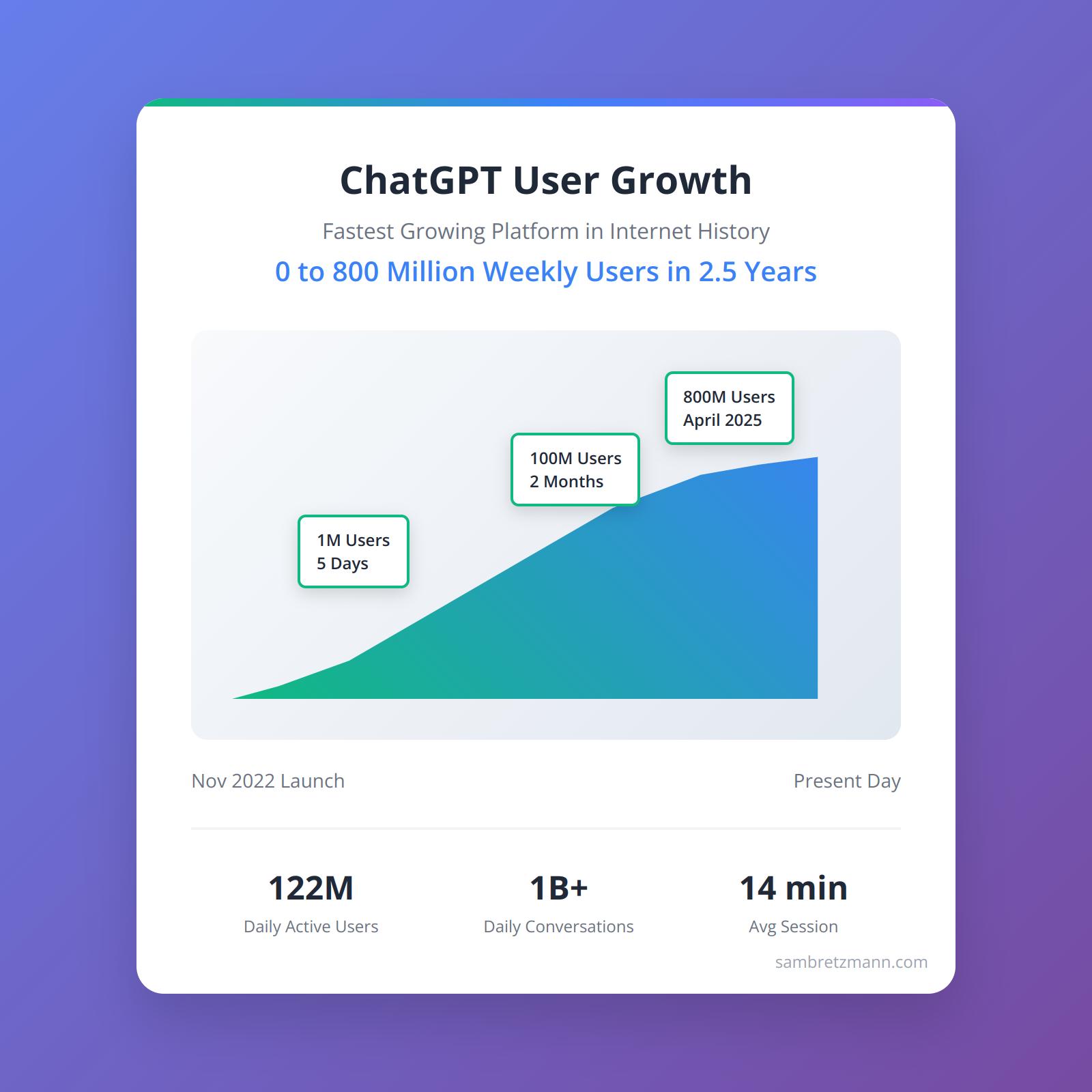
Therefore, it wouldn't be an exaggeration that a generative model like ChatGPT actually pioneered the AI development race, with rival companies Google and Microsoft following suit.
Instead of creating original content based on your prompt, generative AI can also summarise text, analyse data and images, and provide you with insights. For example, you can ask ChatGPT to analyse an X-ray report, and it will give you proper details about the medical details, as shown in the image. You can ask it to simplify complex medical terminology or any other text, or to elaborate on specific topics as needed.
Key Characteristics of Generative AI Models
- The most notable characteristic of generative AI is its ability to generate unique content based on prompts. Unlike traditional AI that was creative, generative models can create content of different formats, like texts, images, video, music, and even code.
- Generative AI models can identify patterns and structures. They can do so because of the massive training datasets fed to them. This is why they are also called trained models to recognise patterns in data to predict the next outcome in sequence.
- Another notable characteristic of gen AI models is that they need prompts to generate content. Technically, a user interacts with the chatbot and writes prompts based on which it responds. So, it enables prompt-based interaction with the user.
- We are now in the era of sophisticated multimodal generative AI such as Stable Diffusion, Google's Gemini and OpenAI's GPT-4. These models can create content across different formats and blend data types to simulate human-like mental processes in terms of reasoning, problem-solving and understanding with emotional intelligence.
- Because of their ability to recognise patterns in data, the generative AI model can predict the next element in a sequence rather than latching on to a genuine understanding.
- Since the models can be finetuned based on feedback loops, they can also provide you with a tailored content generation experience based on your prompts or preferences.
- One of the most distinguished and equally disturbing traits of generative models is that they suffer from the technical syndrome called hallucination and sycophancy, something OpenAI has already confessed to.
What is Agentic AI?
Agentic AI is based on artificial intelligence technology, but unlike its generative AI counterpart, it doesn't require users' prompts. Agentic AI or AI agents work on their own. They are autonomous agents that can set goals, plan and execute complex multi-step tasks with limited or no human supervision.
Based on the definition, smart AI agents don't rely on much human intervention. Once they have been instructed with goals, they engage autonomous mode to plan and execute the goals.
However, it doesn't rule out human supervision entirely. It is needed in circumstances when human engineers have to readjust the task instructions or command new instructions to the agent. So, basically, the AI agents may have limited human supervision or work completely autonomously.
How is Agentic AI Different from Traditional AI?
Agentic AI differs from traditional AI for several reasons. First of all, you don't have to supervise agentic AI all the time. They mostly work on their own, requiring almost no human input. On the other hand, traditional AI is a narrow smart agent that requires human input and supervision.
Once programmed about tasks and goals, agentic AI can start executing the same through multi-step processes. Traditional AI doesn't have this autonomousness. It performs isolated tasks, meaning it is good at performing single, specialised tasks within predefined rules and boundaries. The working condition of AI agents doesn't change or rely on any change in the current condition. On the other hand, traditional AI is subject to retraining depending on every new change in its condition.
Examples of Agentic AI
Autonomous systems like agentic AI perform complex tasks through planning and reasoning. Examples of these agents are:
- Autonomous customer service agents
- AI travel planners
- Automated claim processors
- Specialised agents in software engineering, finance, and healthcare
How Does Agentic AI Work?
- Customer service agentic AI systems, for example, can manage end-to-end queries, solve problems, offer tailored service, and can also perform multiple steps across applications such as Slack or Salesforce.
- Agentic AI trading bots like Trade Ideas can make a thorough analysis of live stock prices and economic indicators to perform automated trades by identifying patterns with utmost accuracy and speed.
- Agentic AI personal assistants (like Otto and Romie) can handle multiple tasks such as booking flights, hotels and updating calendars by interacting with other agents.
- Agentic AI tools like Cursor and Claude Code can make sound analysis of datasets, create SQL and debug code.
- Agentic AI in claim settlement performs tasks like reasoning, learning and taking action to manage the entire claim lifecycle. For example, Allianz, launched in 2025, is designed to automate high-frequency claims like food spoilage. Another agent called Akira AI carries out insurance claims adjustment by using a host of specialised agents to evaluate losses, check for fraud and recommend settlements.
What are the main challenges for agentic AI systems?
- Despite having huge potential to bring forth transformative solutions in planning, reasoning and executing tasks, agentic AI systems are not without some perceptible challenges of their own. For example, the very fact that they are autonomous is also their disadvantage in terms of causing some serious fallouts if it goes haywire.
- There is a strong likelihood that these agents would behave unexpectedly when encountering novel situations that they are not programmed to handle in a specific way.
- Since agentic AI systems are autonomous, they can behave unexpectedly, like self-driven behaviours that may continue escalating.
- Sometimes, it is very difficult to evaluate why an agent took a specific action, revealing a lack of transparency in their working nature.
- Agentic AI systems may have integration problems when connecting to legacy systems, thereby posing a major technical hurdle.
Use cases of generative AI
Generative AI is hailed as a quantum leap in technological innovation by enabling the creation of new text, code, images, and audio, together with automating complex workflows and improving decision-making.
Some of the key use cases of the technology are mentioned in the following ways;
Content & code generation and marketing
ChatGPT, Gemini and related large language models are used comprehensively to create unique blogs, articles, white papers, and other marketing materials faster. Not only this, the generative models like Claude pave the path for code generation, including performing other tasks like maintaining code, debugging and helping developers with app testing during app development phases. In addition, generative tools can also facilitate the creation of high-quality technical documents and materials to support the application development process.
Customer support, fraud detection, and risk management
AI-powered chatbots and virtual agents have become the number 1 priority use of generative AI for businesses around the globe. From answering customer and human agent questions in natural conversation to maintaining context-aware responses around the clock, Generative models are revolutionising customer service distinctly.
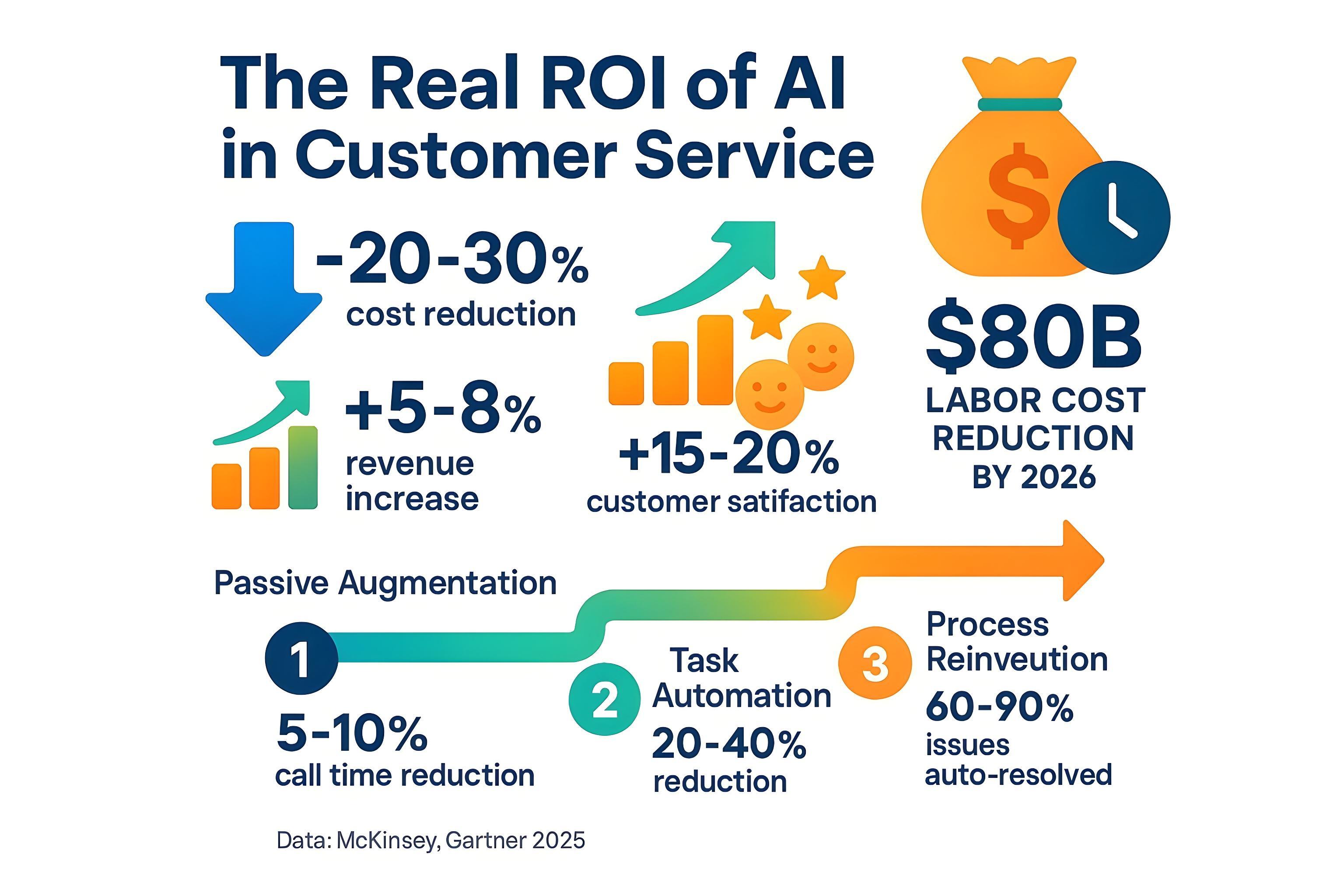
In addition, generative AI is paving the path for fraud detection and risk management within financial services, insurance, SaaS, travel and government sectors by streamlining decision-making through tailored reports and insights.
Revenue generation and cost optimisation
Generative AI is helping businesses to analyse the market landscape to identify growth opportunities or position their brand to grow faster.
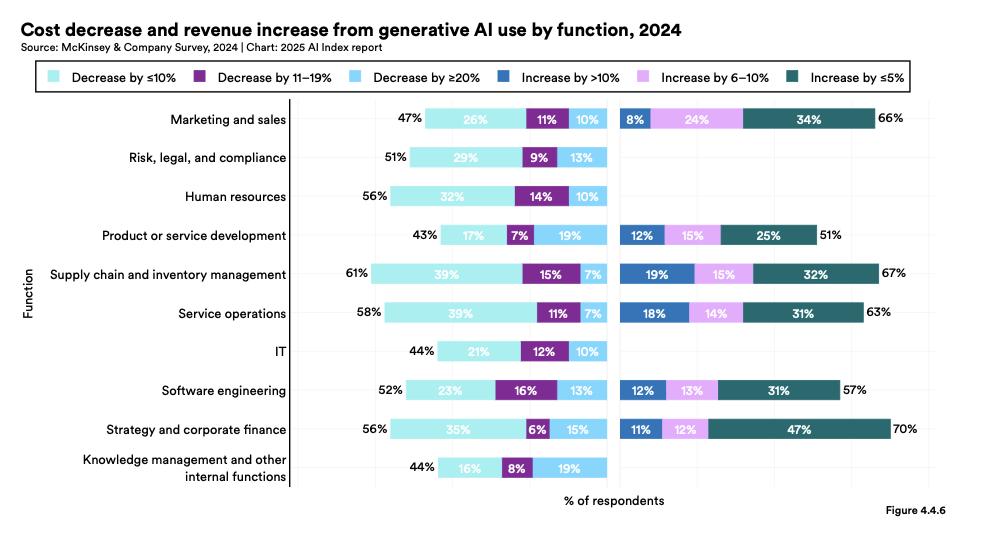
Furthermore, the technology enables companies to cut short on their business expenses without compromising values, automate and refine processes, and ensure efficient resource allocation.
Healthcare, human resources, and product development
Gen AI is contributing significantly to assisting the healthcare industry in diagnostics, patient engagement and drug discovery, apart from assisting with medical documentation. From analysing X-rays, medical imaging, and CT scans to detecting fractures and diseases, the use of generative AI also involves modelling molecular structures, predicting the efficacy of new compounds nad expediting the development of novel treatments.
Furthermore, generative AI streamlines HR processes such as automating interview-scheduling of already screened candidates, personalising role-based training materials of onboarded employees, and generating career development insights.
In product development, the use of generative AI serves the purpose of optimising design concepts at scale.
Once integrated with the entire product development lifecycle, from ideation to procurement, the generative model can deliver impactful computer-aided engineering (CAE) involving creation, simulation, optimisation, and validation of a product's design structure. Another use case in the context of product development is that generative AI enables product managers to improve products based on the feedback of users.
Supply chain, legal and compliance
The use case of generative AI in supply chain involves transforming workflow and operational efficiency of the industries by improving logistics, inventory management and making demand projections. Generative AI enables automotive and other industry players to immediately respond to risks rather than depending on the reported problems of their partners.
For this, the industry players integrate generative models with clean and trusted data across the supply chain, enabling it to generate accurate, real-time information. In the context of legal and compliance, generative AI comes in handy in summarising legal documents, contracts, and regulations, helping legal professionals in research and compliance monitoring, as well as streamlining due diligence processes in legal environments.
Synthetic data creation
This use case of generative AI accentuates its relevance and worth in today's time, where key players like OpenAI and Google take the world by storm with their new AI-powered products. Since AI models require costly and thorough training on datasets that are too expensive to be afforded by AI companies, the AI agents are now deployed to create synthetic data for training purposes related to improving AI model performance.
AI agents are deployed to create training datasets and test products and simulate real-world scenarios, enabling companies to cut short their reliance on sensitive or expensive real-world data to ensure performance upgrades of AI models.
Impacts of agentic AI on the enterprise
Agentic AI systems are groundbreaking in the sense that they can bring forth transformative opportunities that enterprises can leverage for their growth and bottom-line performance boosts.
Since AI agents are intelligent and can perform tasks on their own with limited human intervention, they have enabled companies to think of making inroads in a business model called autonomous enterprise to ensure optimisation of their business productivity at scale.
In addition, agentic AI systems can also be impactful for enterprises in different ways. For example, they can be used to automate the entire customer support lifecycle, supply chain adjustments, reduce operational costs, and outcome 50% faster process time.
Impacts of generative AI on the enterprise
Generative AI is considered a force multiplier for enterprises by super-enhancing their operational efficiency, employee productivity and customer experience. As a versatile tool, it supports enterprises in marketing, communications, research and development, operation and analytics. It paves the path for operational and strategic shifts impacting key business functions, including IT and Engineering.
Final thoughts
The comparative differences between agentic AI and generative AI showcase their individual capabilities in different application areas. However, they all boil down to a single critical fact: these cutting-edge technologies are reshaping the world in their own distinctive ways, infusing innovation, scalability, and automated efficiency.

Frequently Asked Questions
Blogs and Articles
- Sep 12, 2026
- Technology
Why EIMT’s Online DBA Is a Top Choice for Working Professionals
- Discover why EIMT is a top choice for working professionals pursuing an Online DBA, offering flexibility, career growth, and advanced business expertise.


- Sep 11, 2026
- Technology
- Aug 28, 2026
- Technology

- Aug 14, 2026
- Technology