

 United Kingdom

 Switzerland

 United States


















 Italy
 France
 India
 UAE
 Germany
 Russia
 Malaysia
 Spain
 United States
 Malta

7 AI Concepts Every Software Developer Needs To Know in 2027
7 AI Concepts Every Software Developer Needs To Know in 2027
Did you ever wonder how ChatGPT answers your question in seconds? What exactly happens between your question and the answer generated by the AI model?
You may not know this, but behind every interaction you make with an AI chatbot, there sits a stack of tokens, models, context, retrieval, tools, evaluations, and infrastructure.
For a software developer, treating this stack as a black box and not trying to figure out what lies beneath its internal mechanisms is something they can’t afford.
When building, scaling, and maintaining modern applications, as a developer, you need to master the fundamental layers of the LLM stack. It is vital if you want to keep your skills sharp, stay relevant, and build software that is a success in this automated era. You can’t go far in your career without looking beyond basic prompt engineering and learning the real mechanics driving AI technology.
The blog features 7 critical AI concepts for software developers to master in 2027 to stay relevant in their careers and learn what it takes to build next-gen applications.
Large Language Models (LLMs)
Large Language Models (LLMs) are a type of artificial intelligence trained on massive amounts of text data to predict and generate human language. Basically, they predict what the next word will be in a piece of text. ChatGPT is a fine example of an LLM where you feed it a piece of text, and it generates answers accordingly.
Because LLMs are fed billions of pages of books, articles, code, and conversations, they become excellent at writing essays, debugging code, translating languages, and chatting like a human. Since they have to predict the next word in sequence, they are trained to learn grammar, facts, reasoning, and context.
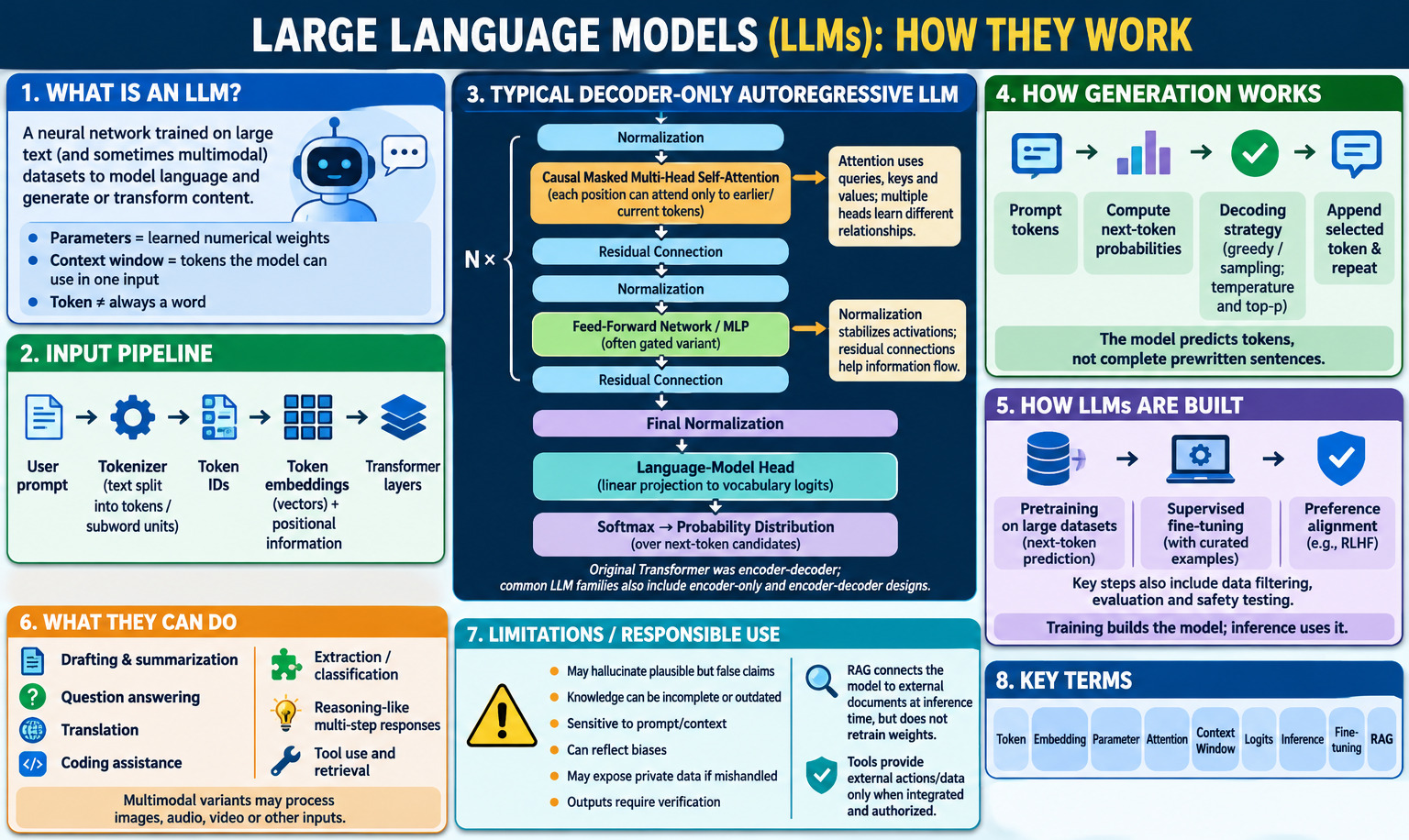
It may sound like LLMs are basically a mechanistic form of humans, but they don't know the facts humans do. This is why they sometimes hallucinate or fabricate answers. The ability of LLMs to predict the next word in a sequence is due to their neural network architecture called the Transformer, which technically does a great job at handling sequences of words and capturing patterns in text.
How developers can use LLMs:
- Generate functions, scripts, boilerplate code, and application components from natural-language prompts.
- Understand unfamiliar codebases, complex functions, and programming logic.
- Identify potential errors, explain error messages, and suggest fixes.
- Generate API documentation, technical explanations, and code comments.
- Produce unit tests and test cases for different application scenarios.
- Suggest improvements to code readability, structure, and maintainability.
Why do developers need to understand LLMs in 2027?
Developers need to understand LLMs because coding is more or less an automated process. Also, interacting with computer systems has become easier due to natural language and intent-driven engineering. Therefore, understanding LLMs means learning how to integrate AI models into applications, select the best models, manage token consumption, structure prompts, and improve generated responses.
While knowing LLMs is good for developers, they should verify code quality, security, factual accuracy, and performance before deploying LLM-generated outputs.
Prompt Engineering and Context Engineering
Prompt engineering and context engineering are two of the most important concepts software developers need to understand to be able to communicate with AI models skillfully.
Prompt engineering is basically the art of eliciting the best response from an AI model. For this, a prompt engineer should know how to design and refine instructions or creatively worded instructions to the AI model.
In fact, the quality of the response an AI model generates depends largely on the quality of the instructions it receives from the users. This means a vague prompt may produce a generic or incomplete response, whereas a well-crafted prompt can produce output better matching the application’s requirements.
How developers can improve prompts:
- Specify the technical role the model should assume, such as a senior Python developer or database architect.
- Explain exactly what the model needs to generate or accomplish.
- Provide relevant code, application requirements, programming languages, and frameworks.
- Mention performance requirements, security considerations, and coding standards.
- Specify whether the response should contain code, explanations, JSON, documentation, or test cases.
What is context engineering and why does it matter for developers?
Context engineering is treated as a better approach than prompt engineering. It is beyond writing effective prompts. An expert in this can select, organise, and supply information an AI model needs to complete a task accurately.
For a software developer, context engineering should involve the following approaches when asking an AI coding agent to fix a bug -
- Relevant source code and related files.
- Error messages and application logs.
- Database schemas and API specifications.
- Project architecture and dependencies.
- Previous instructions and conversation history.
The quality of response generated by the AI agent depends largely on whether it has received the right information at the right time.
Why developers need to understand context engineering in 2027
In light of AI applications becoming more sophisticated, developers now require to manage larger contexts, control unwanted information, and present key instructions from being lost in lengthy conversations. The role of context engineering matters when developing coding assistants, enterprise AI applications, customer support systems, and autonomous AI agents.
Retrieval-Augmented Generation (RAG) and Vector Databases
If you have used ChatGPT, you may have noticed that the chatbot uses external information sources on the internet to answer your questions accurately. This is an example of RAG in play in any LLM-based AI model.
No doubt, large language models are powerful, but they have some limitations like hallucinations, inaccuracies, limited or outdated knowledge, and lack of long-term memory. Therefore, Retrieval-Augmented Generation (RAG) comes as an important medium to address such limitations of LLMs by connecting AI models with external information sources.
What is Retrieval-Augmented Generation (RAG)?
Retrieval-Augmented Generation (RAG) is an AI technique/architecture that improves the accuracy and trustworthiness of large language models (LLMs) by connecting them to external knowledge sources before they generate a response.
The feature of RAG is what makes an AI model a meaningful answer-generating engine capable of answering context-specific information in real time. Otherwise, it is just a parametric language model with limitations such as high hallucination risk, knowledge cutoff, and zero awareness of internal documents or events that happened recently.
What does a RAG do?
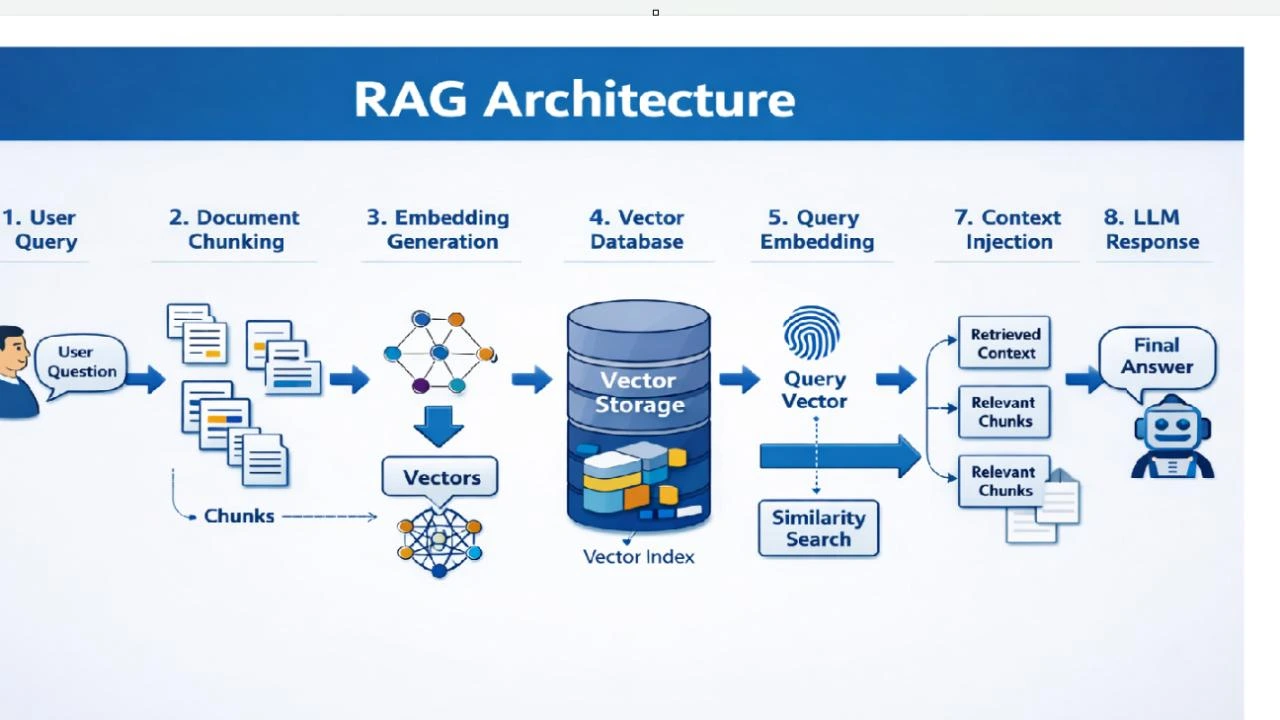
Here’s how a typical RAG behaves:
- Collect information from documents, websites, databases, PDFs, and other sources.
- Clean the information and divide it into smaller sections called chunks.
- Convert the chunks into numerical representations called embeddings.
- Store these embeddings in a vector database or another suitable vector index.
- Convert the user's query into an embedding and retrieve relevant information using similarity search.
- Supply the retrieved information to an LLM so it can generate a contextually relevant response.
What are Vector Databases?
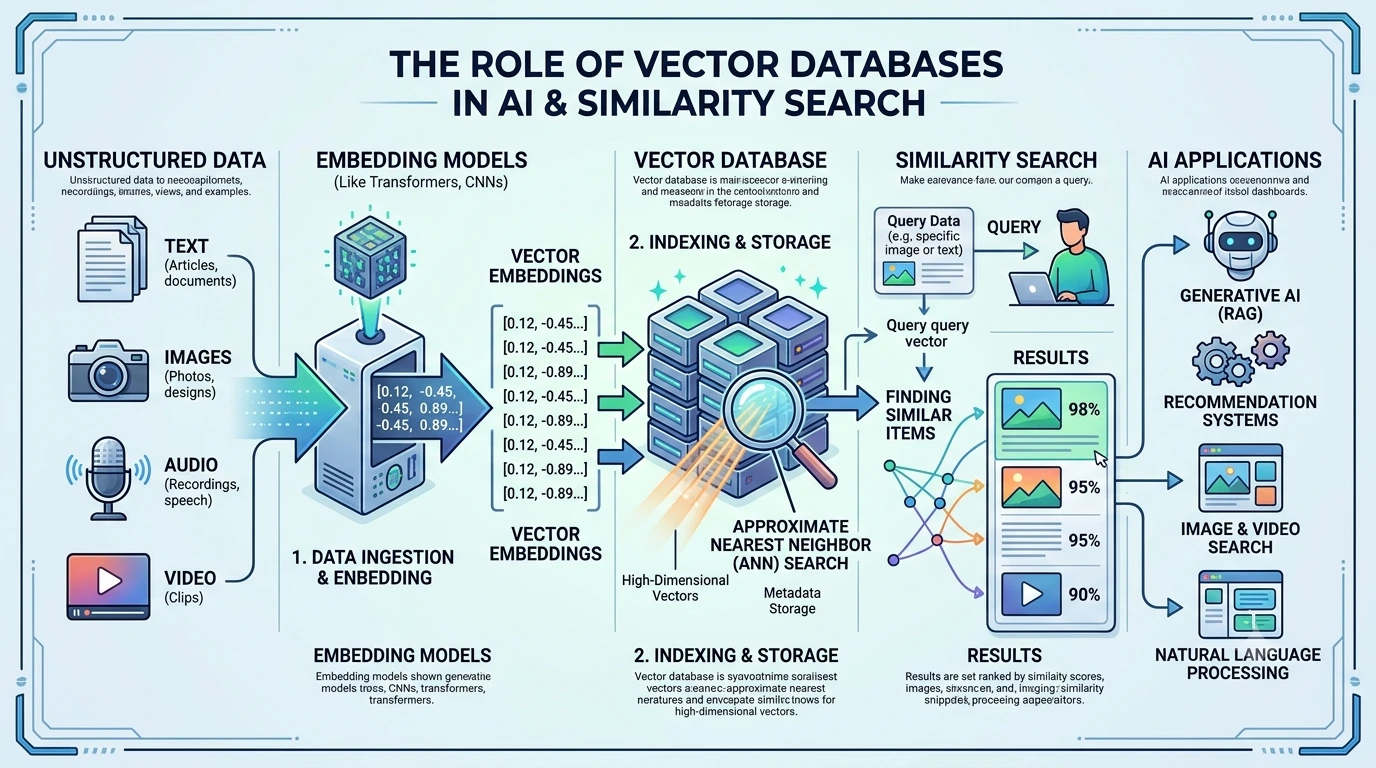
Before defining vector databases, let's understand that efficient data processing plays a powerful role in applications that involve large language models, generative AI, and semantic search. These applications rely on vector embeddings generated by LLMs. These embeddings contain features/attributes representing different dimensions of data essential to understanding patterns, relationships, and underlying structures.
Vector databases are specifically designed to handle this data type, helping AI applications find information based on semantic closeness rather than relying solely on exact keyword matches.
Vector databases include popular technologies such as: Pinecone, Weaviate, Chroma, Milvus, and FAISS.
Why developers need to understand RAG in 2027
Developers need to understand RAG because it has shifted from an advanced AI design pattern to a core competency, where building applications requires access to frequently updated information, private organisational knowledge, technical documentation, and domain-specific data.
In fact, developers who do not understand RAG may end up building applications with no memory, high operating costs, and security vulnerabilities. Most importantly, developers need to understand that RAG does not eliminate hallucinations in an AI application. Incorrect retrieval, outdated documents, and incomplete context can still produce misleading responses.
AI Agents, Function Calling, and Model Context Protocol (MCP)
For software developers, it is important to know that AI applications are no longer limited to just answering questions. Modern AI systems, or agentic AI systems, can interact with external tools, retrieve information, execute workflows, and perform tasks through connected services like external software, databases, APIs, etc. Therefore, understanding AI agents and tool integration is very important.
What are AI agents?
AI agents are autonomous agents, which means they act on their own to perform pre-instructed tasks on behalf of users. They rely on artificial intelligence to make decisions, perceive their environments, and take actions to achieve specific goals. These agents solve complex tasks across enterprise applications, including software design, IT automation, code generation, and conversational assistance.
They also demonstrate reasoning, planning, and memory and can autonomously make decisions, learn, and adapt by processing multimodal information like text, voice, video, audio, and code. Not only do they learn over time, but they also work with other agents to coordinate and perform more complex workflows.
Key principles that define AI agents:
- They act on their own (autonomously), with no or minimal human intervention.
- They act in accordance with the objectives and evaluate the outcomes of their actions in relation to those objectives.
- They perceive their environments using data collected through sensors or digital inputs.
- They are rational with reasoning capabilities and can make informed decisions.
- They prepare according to the events they anticipate, instead of simply reacting to inputs.
- They learn over time by learning from past interactions.
- They can work with other agents or human agents to achieve shared goals.
Why do developers need to understand AI agents in 2027?
The concept of AI agents developers need to understand in 2017 is because agentic AI systems help build intelligent applications, workflow automation systems, enterprise assistants, and AI-powered development tools.
What is function calling?
Function calling, or tool calling, allows an AI model or LLM to connect with external tools, APIs, databases, and code. An AI system with tool calling capabilities does not rely only on pretrained knowledge and can query databases, fetch real-time information, execute functions, or perform complex operations beyond what it is inherently capable of doing.
To simplify, function calling is a feature of LLMs, enabling them to interact with the outside world and run code. In other words, it turns an LLM into a smart decision-maker that can use external tools.
Why do developers need to understand function calling in 2027?
Function or tool calling is essential for developers because the technology empowers LLMs to evolve from being a passive text generator to autonomous agents. With function calling, an AI model can dynamically query databases, execute terminal commands, and perform multistep workflows rather than being limited to just predicting text based on static training data.
What is Model Context Protocol (MCP)?
MCP (Model Context Protocol) is an open-source standard, two-way connection for AI applications to external systems. Basically, it allows LLMs to connect to various data sources and tools.
For software developers, MCP provides a single, universal standard for plugging AI into the digital world, instead of building custom integrations for every AI app and external service.
To understand the context of MCP, you need to understand that LLMs are powerful, but they have limitations like knowledge cut-offs and can’t interact with the outside world. So, accessing real-time data or performing actions like booking a meeting or updating a customer record is not at all possible for LLMs. Therefore, MCP is the open standard that solves this for LLMs.
For example, an AI-powered assistant can use MCP to connect with cloud-based services, local project files and repositories, or External APIs and business applications, depending on the requirements.
Why do developers need to understand MCP (Model Context Protocol) in 2027?
Because MCP has become the universal standard for connecting AI models to external tools, databases, and enterprise data. Obviously, the LLM feature is replacing the need to write and maintain messy, custom point-to-point integrations. Therefore, developers can use MCP to build an integration once, and it works across compatible AI hosts.
Fine-Tuning, Transfer Learning, and Model Selection
Training a model from scratch is not something every AI application needs. In most cases, developers can use a current pre-trained model and adapt it to a specific requirement. This is where fine-tuning and transfer learning become relevant.
What is fine-tuning in AI?
When a pre-trained AI model is adapted for specific tasks or use cases, the process is called fine-tuning. It is considered quite an efficient alternative to avoiding building and training an AI model from the beginning and instead use an existing, pre-trained model by updating all its parameters using the new dataset.
Fine-tuning vs RAG: A Tabulated Guide
|
Comparison |
Fine-tuning |
RAG |
|
Primary purpose |
Adapt model behaviour. |
Supply external knowledge. |
|
Main approach |
Further train a pretrained model. |
Retrieve relevant information. |
|
Data requirement |
Training examples. |
Documents and knowledge sources. |
|
Updating information |
May require further training. |
Update the external knowledge base. |
|
Common applications |
Classification, specialised output formats, domain-specific behaviour. |
Document search, enterprise knowledge assistants. |
|
Main consideration |
Training cost and data quality. |
Retrieval quality and information freshness. |
What is transfer learning?
In the context of machine learning, transfer learning is defined as a technique in which an AI model trained on one task or dataset is fine-tuned for a new, related task.
We know that training a new ML model requires a massive amount of time, effort, computing power, and several iterations. It is a herculean task, to say the least. To avoid that, organisations use transfer learning techniques to retrain an existing model on related tasks with new data.
For example, a pretrained language model that understands general English can be used to handle specialized legal, financial, or technical language.
What is model selection?
Model selection is the process of selecting the right machine learning model from the pool of candidate models for specific tasks. The purpose is to pick a model that performs accurately on new, unseen data rather than just memorizing or fitting the training data.
Model selection matters for various reasons. For starters, it keeps a model from becoming too complex so that it can generalise well to new data. Secondly, it ensures that the model captures important patterns, and thirdly, it weighs accuracy against speed and memory use. Also, picking the right model ensures high prediction quality and precision.
How should developers evaluate model selection?
Developers should evaluate model selection in the following way:
- Accuracy: Can the model produce reliable results for the intended task?
- Latency: How fast can it generate a response?
- Cost: What is the cost of inference, API usage, and deployment?
- Context window: How much information can it process in a single request?
- Privacy: Can the model meet the application's data protection requirements?
- Deployment: Does the application need a cloud API, a self-hosted model, or local inference?
Why do developers need to understand fine-tuning, transfer learning, and model selection in 2027?
The role of a software engineer has taken a drastic shift from writing code to orchestrating intelligent systems. Since foundational AI models are integrated into the modern tech stack, developers who treat these models as a surface-level knowledge base or black boxes are at greater risk of becoming obsolete.
Developers need to make informed decisions rather than automatically choosing the largest or most popular model, considering as the AI model ecosystem expands.
Understanding fine-tuning, transfer learning, and model selection are core engineering skills software developers must develop to build cost-effective, high-performance, and secure applications.
Multimodal AI and AI Model Integration
If we talk about traditional AI applications, we know that they were designed to process a single type of input, like text or numerical data. Technically speaking, their capabilities to process inputs were limited compared to modern AI systems that are increasingly capable of understanding and generating various types of information.
What is multimodal AI?
A multimodal AI is a machine learning model that can process information from different modalities, such as images, videos, and text. Google’s Gemini is a fine example of a multimodal chatbot that can generate a written recipe based on an image of cookies and vice versa, because newer versions of Gemini (like Gemini 1.5 Pro and Gemini 2.0 models) are natively multimodal.
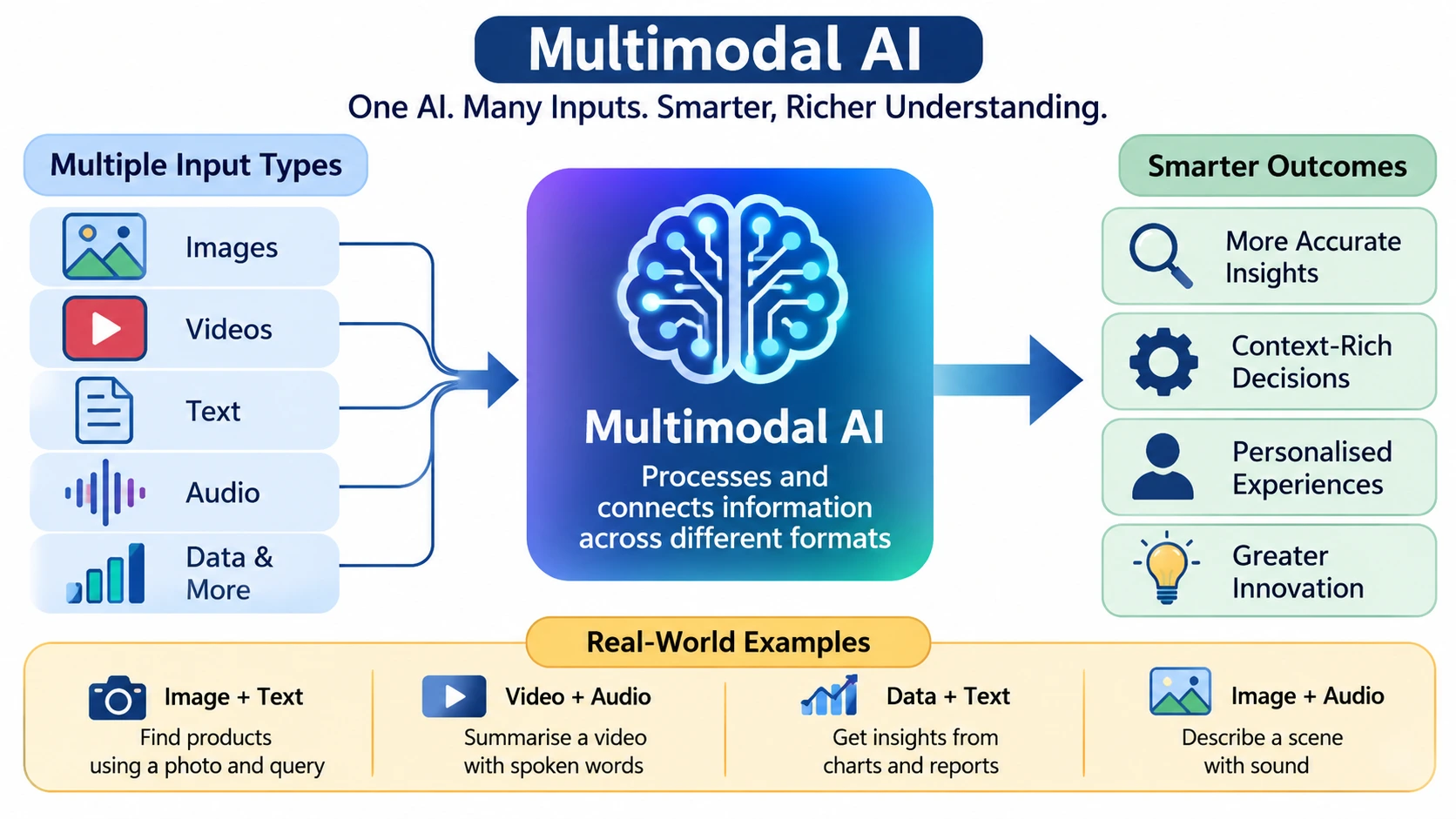
Multimodal AI is an enhanced version of generative AI that only creates new content. On the other hand, multimodal AI handles things on a deeper level, like processing information from different modalities, including images, text, and videos.
How can software developers use multimodal AI in 2027?
Software developers can use multimodal AI in different ways. Some of them are mentioned in the following ways -
To recognise and analyze images
Vision-capable AI models allow software to see and interpret visual data just like humans. By integrating the advanced vision-capable AI models into applications, developers can unleash powerful automation capabilities, from analysing photographs to identifying objects, extracting information from documents, and interpreting screenshots. To exemplify, an e-commerce application could allow customers to upload a product photograph and find visually similar products.
Speech recognition and voice applications
Speech recognition allows software to convert spoken language into text. Developers can use it to build voice assistants, automated transcription tools, and hands-free application interfaces.
Video understanding
AI-powered video analysis can identify objects, summarise visual events, and extract useful information from video content. For example, developers could create an application that analyses recorded training sessions and generates summaries of important discussions.
Document intelligence
Multimodal AI can interpret scanned documents, charts, tables, and images. This is useful when building applications that process invoices, receipts, reports, and business documents.
Recommended technologies and platforms developers should explore include OpenAI API, Google Gemini API, Hugging Face, Whisper, and PyTorch.
Why do developers need to understand multimodal AI in 2027?
Multimodal AI allows software developers to create more interactive applications easily accessible. Rather than restricting users only to text-based instructions, developers can build systems that understand images, voice commands, videos, and other forms of input. Hence, understanding multimodal APIs, model capabilities, file processing, data formats, and input validation will be valuable for developers to build these applications.
What is AI Model Integration?
In any software application, integrating smart AI machines transforms it into a dynamic system that can learn, predict, and automate tasks. AI model integration works just like that. It is the process of embedding AI models, machine learning algorithms, or generative AI tools directly into existing software apps, digital platforms, and business workflows.
Therefore, AI model integration technically becomes a native part of the system to process data, identify patterns, and automate tasks in real time.
Why do developers need to understand AI model integration in 2027?
Because software engineering no longer remains attached to tasks like writing every line of custom logic and is moving toward tasks like architecting, connecting, and supervising AI-native systems. Industry predictions by Gartner anticipate that nearly 80% to 90% of enterprise engineers will work with AI-assisted or AI-integrated architectures.
It indicates that core integration skills will become at least mandatory baseline skills than a niche specialisation, meaning software developers need to understand and cultivate AI model integration skills to stay relevant in their job in a future dominated by AI.
AI Evaluation, Observability, Testing, Security, and Guardrails
For software developers, building an AI-powered app is just a single part of the development process. Because ensuring that the app works as per expectations is also very important. The thing with traditional software testing is that it tests an app based on how it generates output for a given input. On the other hand, AI applications could be problematic in terms of trust and accuracy of their generated output.
What is AI Evaluation?
AI evaluation simply means assessing whether an AI system or LLM model produces the right, accurate, and reliable outcomes against the input it is given. This is a technical process of measuring the model’s performance against defined quality standards and application requirements. For software developers, AI evaluation skills are vital to determine whether the model/system produces accurate, relevant, consistent, and useful responses.
What is AI Observability?
To ensure that an AI app behaves perfectly without any performance issues, the role of AI observability becomes important. It involves scrutinising an AI app’s behavioral partners during its development and production stages. The goal is clear - to help developers spot performance issues, unexpected model responses, rising API costs, and failures in connected services.
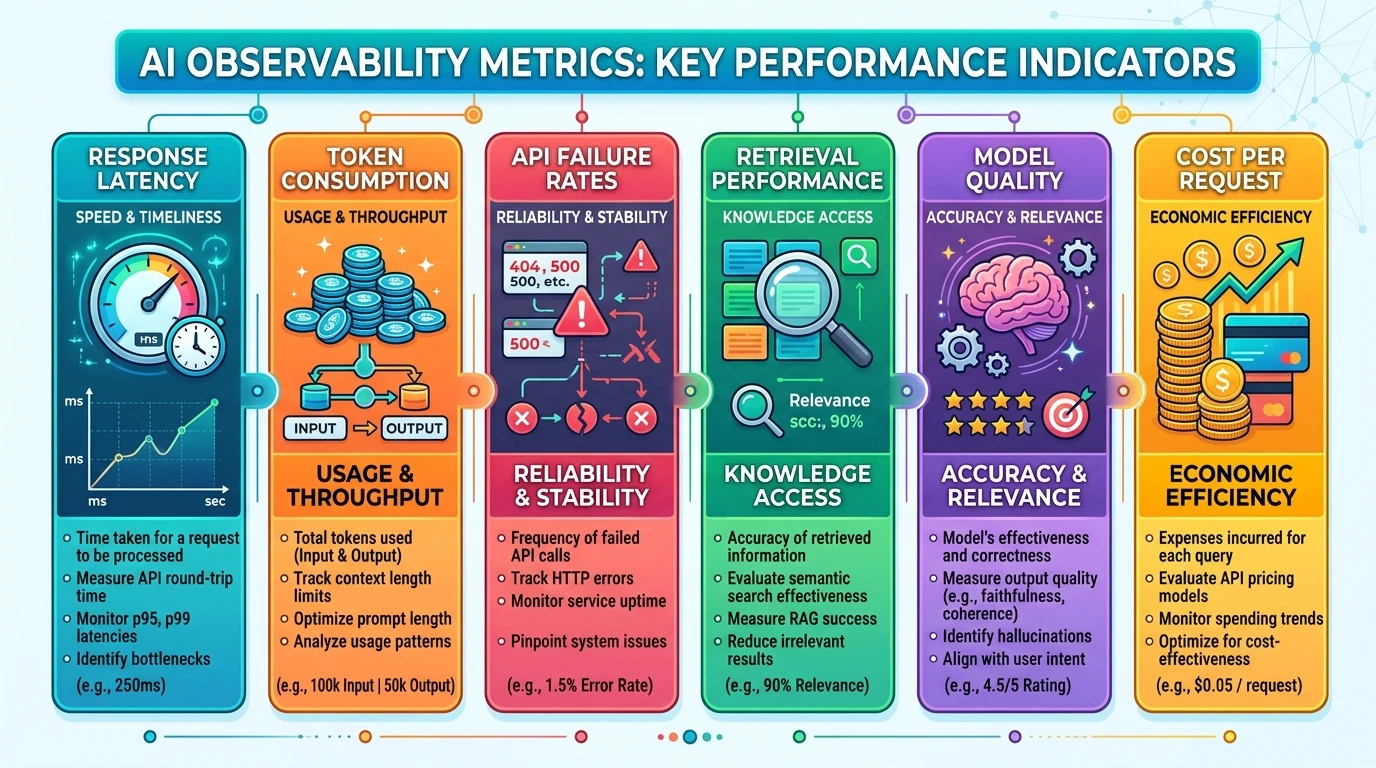
This is important for developers because a traditional application performance monitoring system or APM only tells you if a server is up. AI observability helps developers debug performance issues like why a multi-step agent or RAG (Retrieval-Augmented Generation) pipeline drifted, hallucinated, or failed deep inside a hidden workflow.
What is AI testing?
AI testing is an evaluation process of machine learning (ML) models, large language models (LLMs), and data-driven applications to ensure their accuracy, reliability, safety, and risk-free performance. AI testing is important for developers to catch hallucinations, mitigate bias, legal risks, defend against security threats, and handle data drift to ensure continued performance of the app.
What are AI Guardrails?
AI guardrails are like putting safety measures on AI models, applications, and autonomous agents to ensure they don’t deviate from their programmed behaviours by governing their inputs and outputs. Just as physical barriers on a highway keep vehicles from veering off course, AI guardrails also ensure that the AI agents/systems do not deviate by inspecting their prompts, blocking or correcting problematic behaviors in real time.
For software developers, knowing the concept of AI guardrails matters significantly to prevent security breaches, data leaks, stop hallucinations, false information, mitigate risks, enforce brand compliance, etc.
Final Words
Modern software engineering is sure to have artificial intelligence as an integral part of its development lifecycle. In 2027, developers will need to understand more than programming languages and traditional SDLC (software development life cycle) frameworks. They must also know behavioral patterns of AI models, how to integrate the models into applications, and how to ensure they are safe and secure.
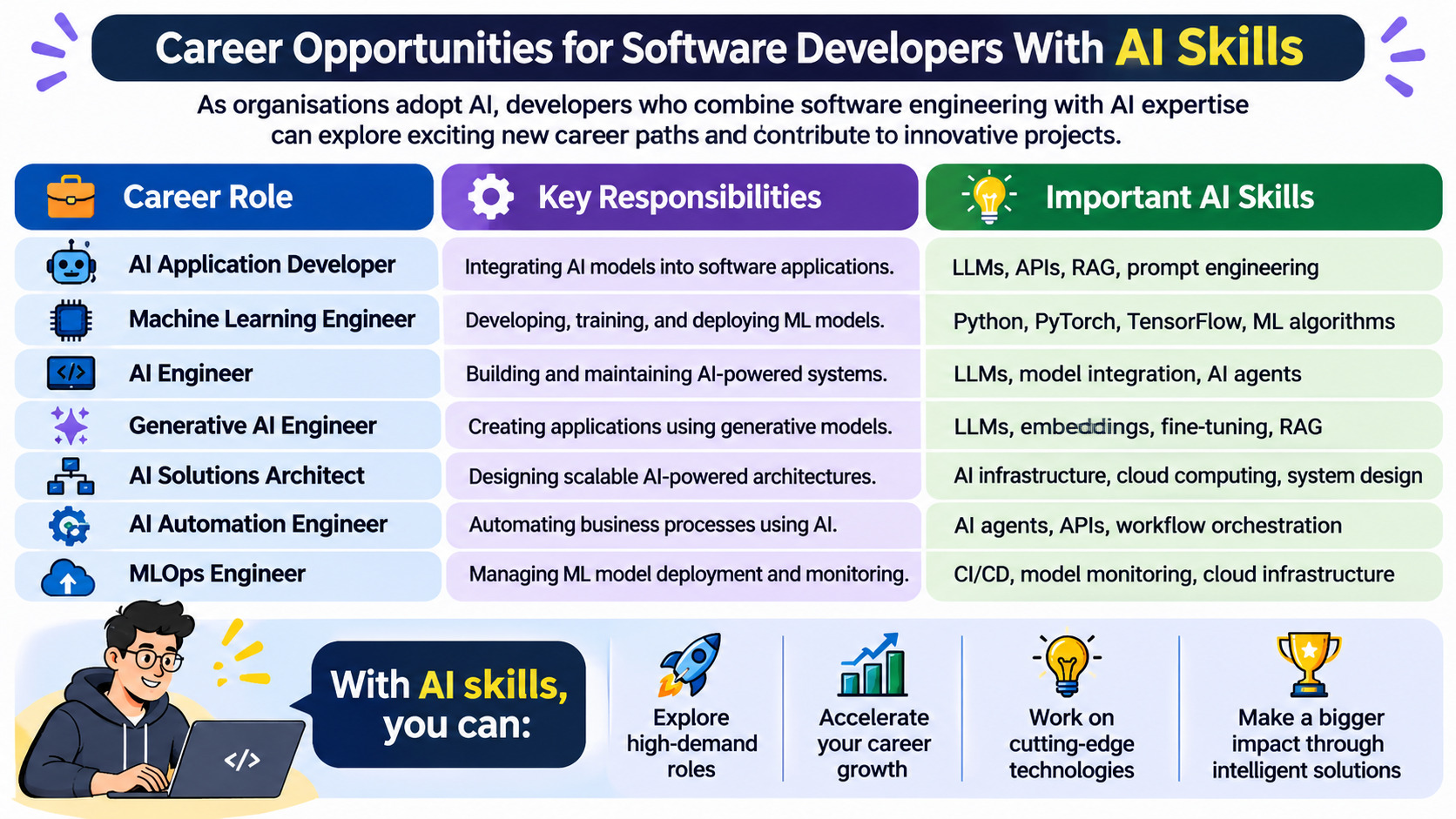
The 7 AI concepts jotted down in this guide give a strong foundation for understanding how the AI landscape is changing and what developers need to know in the context of Generative AI and LLMs, prompt and context engineering, RAG and vector databases, AI agents and MCP, fine-tuning and model selection, multimodal AI, AI evaluation, AI testing, observability, and guardrails.
Learning these AI concepts and related skills does not at all mean abandoning traditional software engineering skills. It is to prepare yourself for the future where AI is to become an integral part of development lifecycles. In fact, the future belongs to the strong developers endowed with core programming expertise, problem-solving abilities, system design, and AI knowledge to build practical, reliable, and scalable applications.
Hence, the goal for software developers in 2027 is to understand how to engineer software systems that use AI effectively, rather than learning how to use AI tools.
Blogs and Articles
- Nov 4, 2026
- Technology
7 AI Concepts Every Software Developer Needs To Know in 2027
- Explore 7 essential AI concepts every software developer should understand in 2027, from machine learning to generative AI and automation.

- Oct 22, 2026
- Technology

- Oct 12, 2026
- Technology