 UAE
UAE
 United Kingdom
 Switzerland
 United States

 Italy
Italy France
 India
India UAE
UAE Germany
 Russia
 Malaysia
 Spain
Spain United States
 Malta
Malta
Top Benefits of Studying in Europe vs the USA: A Student’s Guide
Top Benefits of Studying in Europe vs the USA: A Student’s Guide
Most students ask: "Which country has better universities?" That is actually the wrong question. The smarter question is: "Which system gives me the best return — financially and professionally — for my specific goals?" This article answers that.
Every year, millions of students choose between two powerful higher education systems. Most comparison guides stop at the cost. This article goes further: it explains the math of student debt, why the Bologna Process makes European degrees travel globally, what dual accreditation actually does for your CV, where the USA still holds a clear advantage, and how to match your degree to jobs that will genuinely exist in the next decade.
Before we begin, it is important to clarify that — neither system, Europe or the USA, is universally "better." Both have genuine strengths and genuine trade-offs. The goal here is to provide you information that is authentic so you can decide for yourself.
1. The Real Cost Gap — What the Numbers Actually Say
Let us start with the financial aspect, because it shapes every other decision you make after graduation. The difference in cost between studying in Europe and the United States is not just significant — for many students, it is the difference between starting a career with savings or starting it with debt.
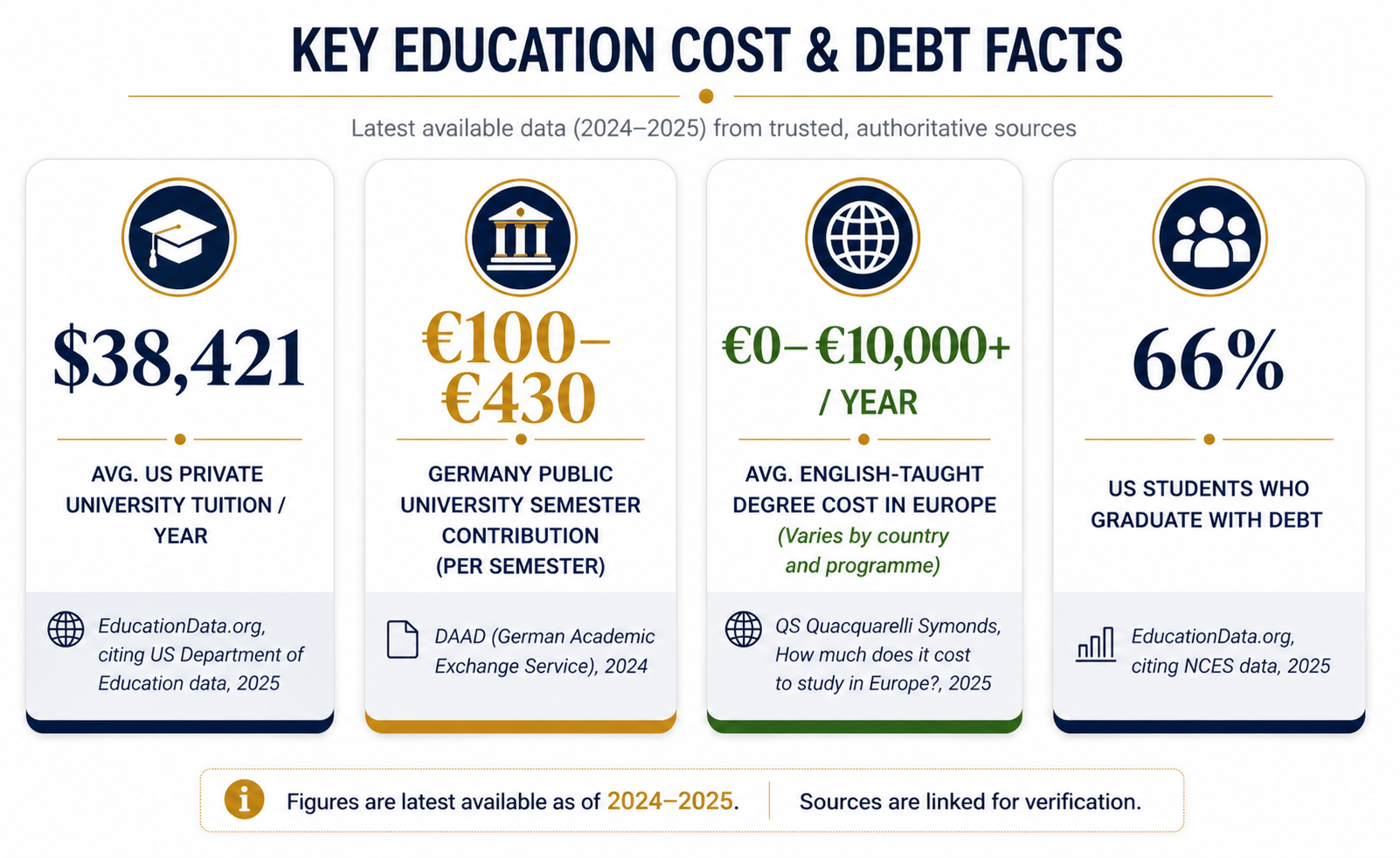
Two facts that need your attention: First, a bachelor's degree in most European countries takes three years, compared to four years in the United States under the Bologna Process framework. That is an entire year of tuition, living costs, and foregone salary that European students do not have to pay. Second, European programs charge no tuition fees in several countries — but this comes with important nuances that deserve honest explanation.
Germany: "Free Tuition" Requires Nuance
Germany is often advertised as entirely free. The reality is more specific. Most of Germany's 400+ public universities charge no tuition fees for undergraduate and consecutive master's programs — for both EU and non-EU students. However, all students enrolled in German universities need to pay a semester contribution (Semesterbeitrag) of roughly between €100 and €430 per semester, which covers administrative expenses, student union fees, and usually includes a regional public transport pass. One major exception is the state of Baden-Württemberg charges non-EU/EEA students €1,500 per semester in tuition fees at all public universities, that includes well-known universities such as Heidelberg, Mannheim, and Karlsruhe (KIT). Moreover, the Technical University of Munich has also introduced fees of €4,000–€12,000 per year since 2024 for non-EU students. Always verify fees at your specific university and state.
Sources: DAAD (2024); Heidelberg University official fees page; KIT official fees page
According to OECD Education at a Glance 2024 — the most authoritative annual international education dataset — students at private US universities face the highest tuition fees among all OECD member countries. Moreover, in-state students at US public institutions face the second-highest fees among OECD member nations. The average US graduate leaves with approximately $26,500 in debt, and 66% of graduates carry some form of debt. (Source: educationdata.org)
Starting your career owing $26,500 versus owing nothing is not a small lifestyle difference. It changes which job offer you can afford to accept (you may need a higher salary immediately), whether you can afford to do an unpaid internship, how quickly you can save for further education, and your overall financial resilience in your first five years of work.
2. US Financial Aid — The Paradox You Must Understand
This is the segment where the picture becomes more complicated — and more honest. The OECD reports that 80% of US students received some form of financial aid — public grants, scholarships, or government-backed loans — in the 2019–20 academic year. This placed the US fourth-highest among all OECD countries with available data. Elite universities including Harvard, MIT, and Princeton operate need-blind admissions and offer grants — not loans — to qualifying students, which can cover the majority of costs for those from lower income families.
The Net Price Rule — Always Apply It
The sticker price of a US university ($50,000–$80,000 per year at elite schools) almost never reflects what students actually pay after aid. According to OECD data, the US government spends an average of $20,387 per student per year across all educational levels — the highest among OECD nations after Luxembourg. Before comparing any US university to a European one, use that university's Net Price Calculator — it shows your actual estimated cost after financial aid.
The honest conclusion: if you are admitted to a top US university with a strong aid package, your real net cost may be lower than it first appears — and may even be competitive with some European options. For the majority of students attending mid-tier US institutions without significant aid, however, the cost gap with Europe remains very large.
3. The Bologna Process — Europe's Secret Career Weapon
You will find that most articles mention "quality education in Europe" and leave it at that. They almost never explain why European degrees travel so well globally. The answer lies in something called the Bologna Process.
What is the Bologna Process?
In June 1999, education ministers from 29 European countries signed the Bologna declaration at the University of Bologna, Italy (the oldest university in the Western world). Their goal: make qualifications from different European countries comparable across borders. Presently, the agreement covers 49 nations within the EHEA or European Higher Education Area.
For you, the student, this means four concrete things: First, every Bologna-compliant degree uses a standardized credit unit called ECTS (European Credit Transfer and Accumulation System). This means your academic credits are legible to any university or employer in 49 countries. Second, universities issue a Diploma Supplement alongside your degree which functions as an official document that describes your complete academic record, details the grading system used to evaluate your work, and describes how your degree aligns with both national and European educational standards. Employers in Asia and the Middle East and Africa increasingly know how to interpret this document. Third, the 2020 Rome Communiqué committed all EHEA governments to automatic recognition of qualifications across member states. Fourth, the ECTS credit system makes building genuine joint degrees and dual degrees across various countries structurally easier than in the US, where credit transfer rules are institution-specific and often restrictive.
"We will ensure automatic recognition of academic qualifications and periods of study within the EHEA so that students, staff and graduates are able to move freely to study, teach and do research."
— Rome Communiqué, Bologna Process Ministerial Conference, 2020 (Source: ENIC – NARIC)
It is important to note a limitation: the Bologna Process applies to EHEA member states instead of being applicable to all countries worldwide. Employers in the US, Canada, or Australia who are less familiar with European qualification frameworks may still need additional credential evaluation. The advantage becomes most effective when you pursue job opportunities inside Europe or in countries which have EHEA bilateral recognition agreements.
4. Erasmus+ — The Mobility Advantage With No US Equivalent
One advantage of studying in Europe, which most American universities do not provide, is the Erasmus+ program which the European Commission operates. The program which started in 1987 has enabled more than 18 million people to participate in its mobility program. As of the current cycle i.e. 2021 to 2027, it aims to achieve 10 million participants through its mobility activities. (Source: Erasmus+)
What Erasmus+ allows in practice: if you are enrolled at a European university, you can spend one or two semesters studying at another university in a different European country, and in most cases pay no additional tuition fees at the host university, while receiving a monthly mobility grant from EU (typically €300–€600/month depending on the country pair and funding rules). Your credits transfer automatically via ECTS. This implies a student can begin their degree in the Netherlands, spend a semester in Spain, and finish in Sweden, thus gaining authentic international experience, developing language skills, and a multicultural professional network, all within a single degree.
The US has study abroad programs, but they are typically shorter (one semester or less), more expensive (students usually pay their home university's full tuition), and not structurally embedded in the degree the same way Erasmus+ is. This is a genuine and significant structural advantage of the European system for students seeking international careers.
5. Dual Degrees and Dual Accreditation
Dual-degree programs provide opportunities for a student to obtain two distinct academic degrees from two different universities which often exist in different countries through a unified educational program. On the other hand, a dual-accredited degree is a single degree that has undergone evaluations by two different accreditation agencies.
Why does this matter for your career? Because accreditation functions as a quality assessment tool for employers, it serves as their primary method to evaluate candidate qualifications. When a hiring manager in Singapore or Dubai or Toronto sees a degree from an institution they have never heard of, accreditation from a body they recognize closes the trust gap instantly. A business school that holds both AACSB accreditation (the leading US quality body) and EQUIS accreditation (the leading European quality body) has been independently verified against two rigorous international standards, not one.
How Rare is Dual Accreditation?
Fewer than 1% of business schools worldwide hold both AACSB and EQUIS accreditation simultaneously. The institutions that hold both accreditations include INSEAD, HEC Paris, Rotterdam School of Management, and London Business School. A degree from one of these schools signals verified quality to employers in both the US and European markets — a concrete competitive edge over graduates from single-accredited institutions.
The ECTS credit system in Europe makes building these joint and dual degrees structurally easier than in the US. The common credit system and three-cycle degree system of Bachelor/Master/Doctorate which all Bologna-compliant institutions use allows two universities from different European nations to create a legitimate joint program that delivers fully accredited degrees recognized in 49 countries. In the US, the educational system establishes credit transfer agreements through bilateral arrangements which restrict students to specific institutions thus making joint degree programs more difficult to implement and create.
Read Also: How International Dual Degree Open Doors to Global Careers
6. Choosing a Degree That Aligns With Future Job Trends
This is another important segment that most comparison guides overlook. Your degree choice should be based on where jobs are growing and not where they were a decade ago.
The Organization for Economic Co-operation and Development and the European Commission have recently conducted labour market analysis which points to three structural forces that will shape the most rapidly developing employment sectors through the 2030s:
- the transition to green energy and climate technologies
- rapid digital transformation, including AI and data-driven industries
- ageing populations driving sustained demand in healthcare and life sciences
The current situation shows that these trends will continue for a long time because they are long-cycle economic shifts already embedded in policy, investment, and workforce demand.
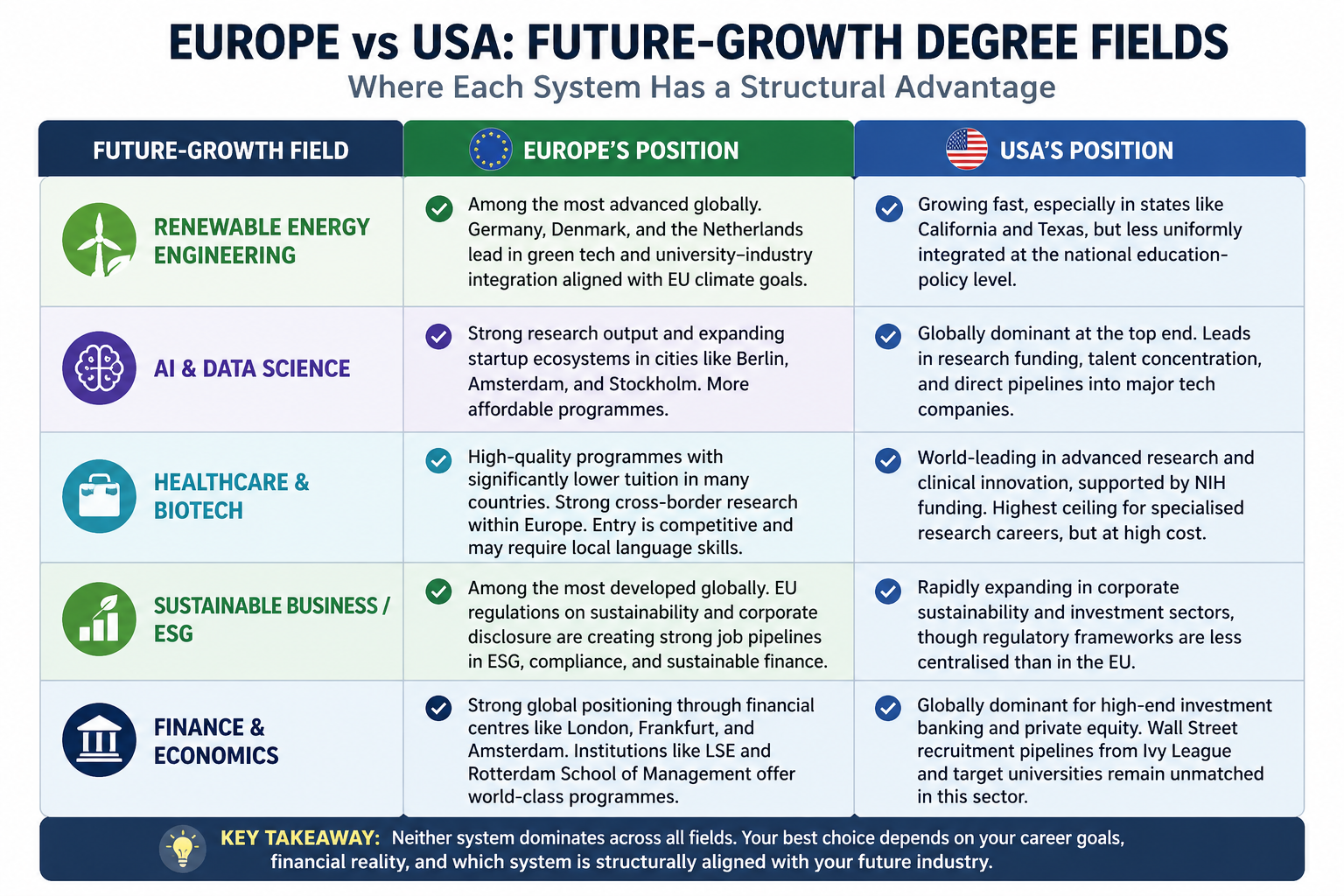
Indicative Comparison
What This Means in Practice
The conclusion is not that one system is universally better. It is that each system is aligned structurally with different opportunity pathways. If your goal is:
- AI roles at leading tech companies globally
- high-level finance roles through conventional recruitment pipelines
then the American system maintains a distinct, evidence-based superiority over the competition.
In case you wish to:
- pursue a career in renewable energies, sustainability, healthcare, or international business
- entering the workforce with less financial risk
- maintaining cross-border career flexibility
then, European programs offer a strategic edge, and often more economically feasible, alignment with those objectives.
Students often miss to recognize the essential strategic insight which proves vital for their academic progress. Your future career path will depend on both — academic field of study and the global economic status of your degree program.
Choosing between Europe and the US requires more than — evaluating ranking or prestige. Your decision depends on your degree, financial situation, and the industries that will define the next decade.
7. Where the USA Has a Clear, Documented Advantage
Here are some of the advantages that give the US an edge in this discussion:
- Brand power at the elite tier
A small group of US universities — which includes Harvard University, MIT, Stanford, California Institute of Technology, and University of Chicago — has name recognition worldwide that provides access to different industries and international markets. According to QS Quacquarelli Symonds employer reputation rankings, US institutions dominate the top tier of perceived institutional prestige which leads to better job opportunities for their graduates. The brand strength of these universities affects how recruiters screen candidates because degrees from these institutions act as strong global signals.
While institutions like Oxford, Cambridge, and ETH Zurich have almost equivalent recognition, the US sees a stronger concentration of universities with this level of global brand visibility.
- Financial aid generosity at elite institutions
Financial aid in the US is often misunderstood when comparing headline tuition. At highly selective universities, need-based financial aid programs provide students with substantial cost reductions, with some institutions covering full demonstrated need. The cost structure for qualifying applicants undergoes a complete transformation because of this implementation, which is why comparisons should focus on net price (after aid, not sticker price). Financial aid varies widely — especially for international students — and should always be checked using each university's Net Price Calculator.
- Domestic career network effects
When it comes to your career being primarily based in the United States, then the network created through alumni from top-tier US universities cannot be overlooked. Recruitment for consulting firms, financial institutions, and major tech companies are often closely tied to structured university pipelines, including on-campus recruiting and internship conversion pathways. Spending four years within this system will develop the exact network that leads you to your success in the US.
- Campus ecosystem and breadth of study
The four-year US undergraduate model gives two years to explore academic interests prior to selecting a specific field of study, allowing students to be flexible and determine their goals. The campus environment — includes student organizations, research, sports, athletics, and startup incubators. In contrast to the more specialized European undergraduate program lasting three years, this is an asset for students exploring diverse options.
What This Means Practically
The United States does not dominate every dimension of higher education. Yet, there remain definite structural strengths for the US in certain domains, such as:
- elite brand power of institutions
- superior research infrastructure
- direct recruitment pipelines into leading global firms
- undergraduate flexibility within academic structures
For individuals who aspire to pursue careers where such attributes play a pivotal role — especially those in elite tech companies, finance, and global corporations — the benefits are clear, tangible, and proven. The key is, however, alignment. Such traits make the biggest impact when they align perfectly with your chosen career track and financial standing.
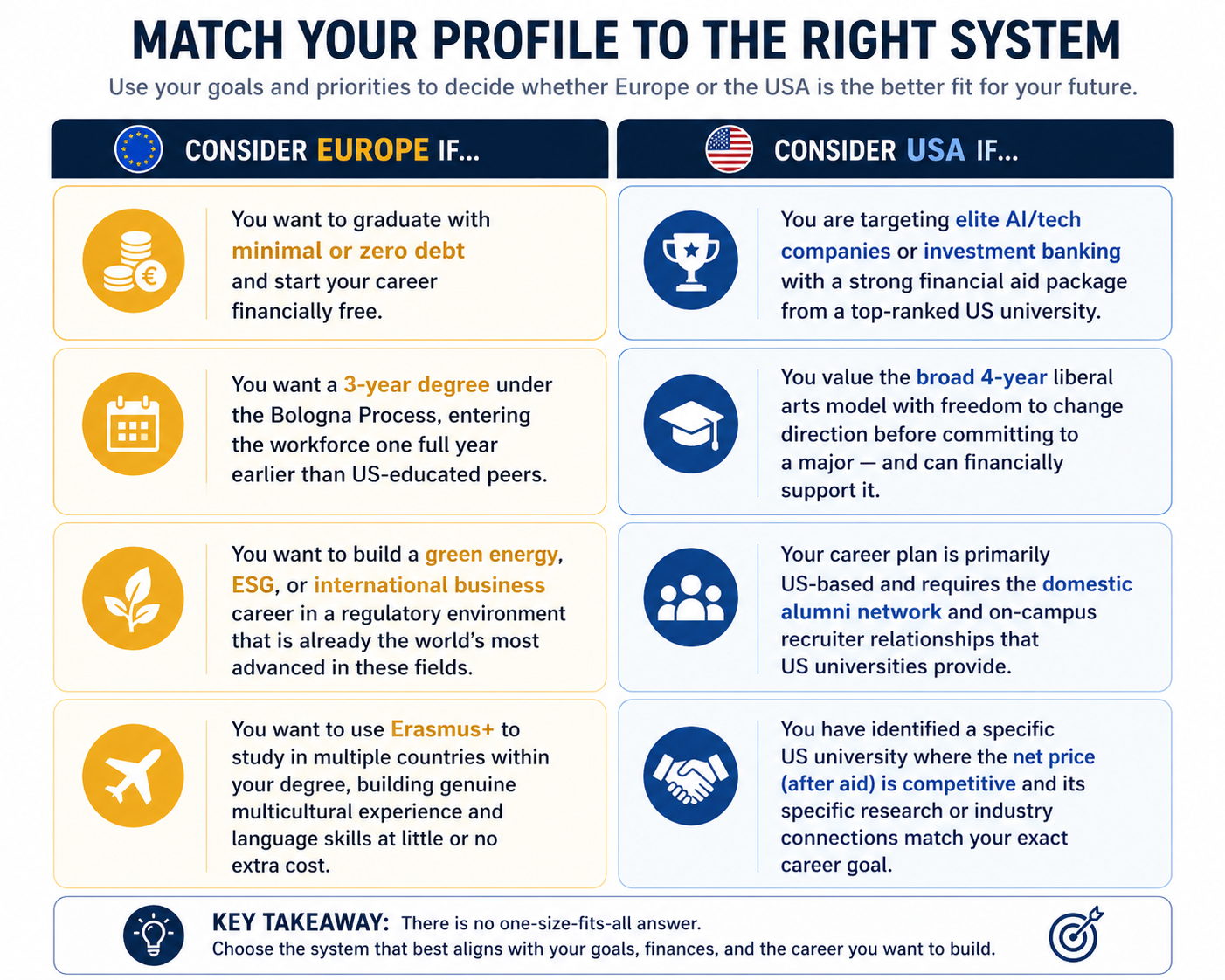
8. How to Choose — A Simple Framework
Stop looking for the "best university in the world." Instead, ask yourself which system best matches your unique needs, finances, and career aspirations. Below framework is based on the information provided in this article.
Conclusion
The article is clear on several points: Europe's relatively affordable tuition fees (with few exceptions), three-year degree structure under the Bologna Process, a globally portable qualification framework that is endorsed by 49 countries, and the unique mobility benefit through Erasmus+. Meanwhile, what makes the United States stand out is its unmatched brand power with the presence of its elite tier of institutions, unparalleled access to US jobs in technology and finance, and a strong financial aid system that lowers the actual cost of education for qualifying students.
We have already seen that neither of these systems is universally superior. The final decision comes down to — what kind of profession you want to pursue, your specific career target, your financial situation, and where you plan to live and work after graduating.
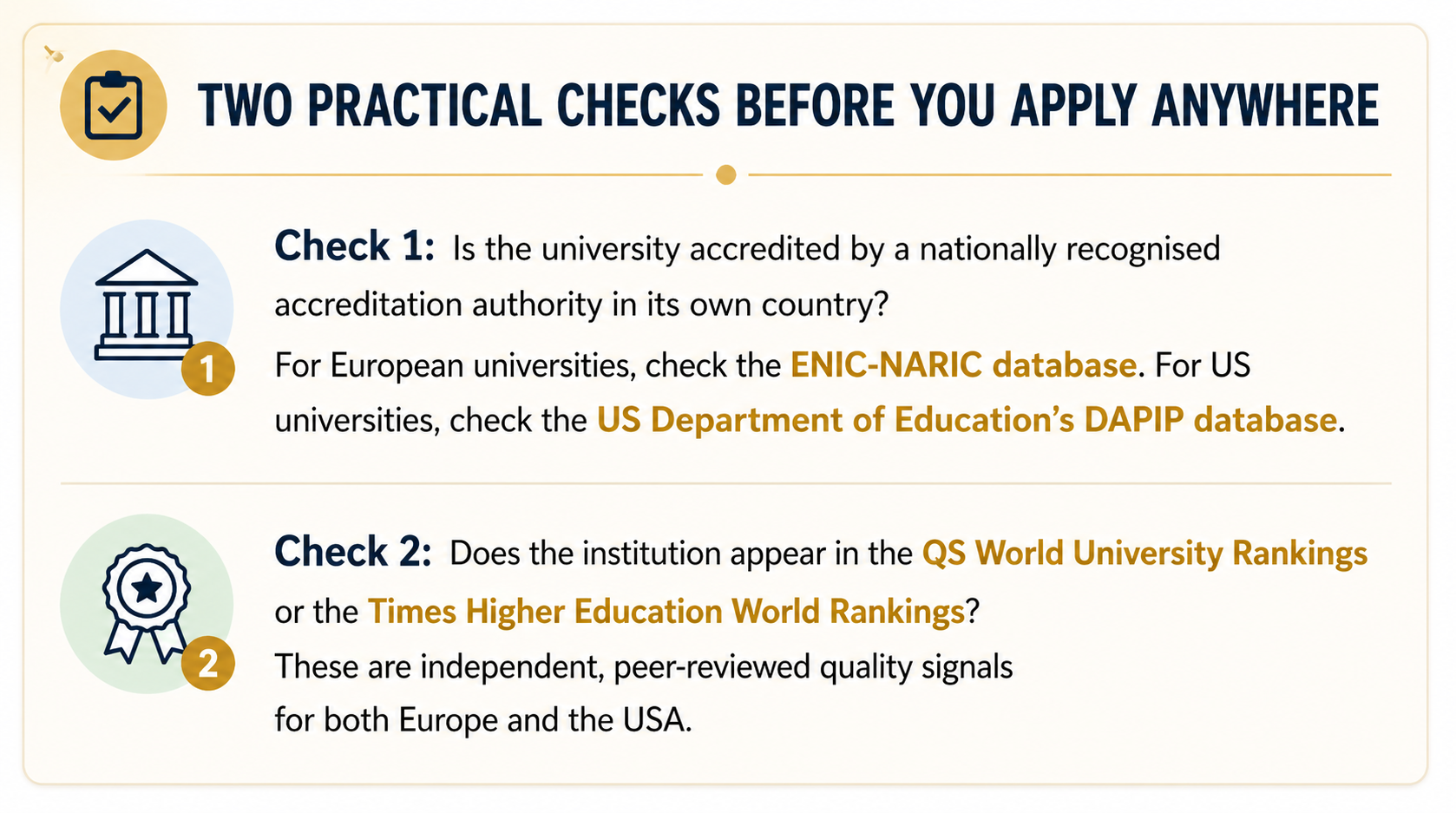
The most important action you can take is to compare net cost — and to verify that the program you select is an accredited one listed in a reputable ranking system such as QS or THES.

Frequently Asked Questions
Blogs and Articles
- Sep 12, 2026
- Technology
Why EIMT’s Online DBA Is a Top Choice for Working Professionals
- Discover why EIMT is a top choice for working professionals pursuing an Online DBA, offering flexibility, career growth, and advanced business expertise.


- Sep 11, 2026
- Technology
- Aug 28, 2026
- Technology

- Aug 14, 2026
- Technology